Monday, October 25, 2010

California Trout and Pigskin

I recently returned from a week long speaking and seminar jaunt through Washington and California.  My journey started as Spokane’s Inland Empire Fly Fishing club welcomed me where I presented my Favorite Western Canada Stillwaters program.  This is the second time I have spoken to the Inland Empire club originators of the best selling book Flies of the Northwest.  Bob Harley and the rest of the club members provided an excellent dinner and in addition to my presentation I tied a few of my favorite flies for them as well.  The Inland Empire club is home to Jerry McBride, originator of the balanced fly concept that has changed the way I tie and present many of my patterns.  It was great to see him and thank him personally for his innovative approach to pattern design.
 
After my evening in Spokane I flew out early the next morning carrying on down to Santa Rosa California where I put on my Going Deep-Sinking Line Strategies for Stillwaters presentation to the Russian River Fly Fishers.  Prior to my presentation club member Joe Banovich took me out to a local smorgasbord restaurant for dinner.  What a spread! I gorged myself silly, totally blowing my diet.  I am a sucker for Sushi in particular and they had lots on hand! 

Lake Davis is a beautiful place to drown flies!
After my presentation was complete I immediately headed north to Clio California where I would be putting on a two day stillwater seminar with Bill Forward.  Bill is the Senior Editor with Sierra Fisherman magazine and owner of Forward Bound Guiding and Fly Fishing Instruction.  

Bills beautiful 16' boat, perfect for a day's fishing!
Over the Friday night and Saturday Bill and I provided two days of instruction to 19 enthusiastic students eager to improve their stillwater fly fishing skills.  Students were provided a number of seminars including how to read lakes, equipment requirements for stillwaters, stillwater entomology, presentation skills, and the intricacies of using indicators on lakes.  In addition to the lectures students were given a chance to get on the water and hone their skills.  At the end of the on the water segment of the seminar Bill and I provided a de-briefing as students discussed their successes, setbacks and observations.  This format provides great interaction and arguably provides the greatest learning opportunity.  Feedback has been extremely positive. This was our first seminar and based upon this positive feedback we are already working on plans for additional seminars for 2011.  Stay tuned to my blog, Facebook page and website for additional details once they are figured out.

Pug nosed Lake Davis rainbow
During my stay I had the opportunity to fish Lake Davis, one of northern California’s most well known stillwaters and one of my ‘bucket list’ lakes.  Fishing was steady and despite the slowly deteriorating weather both Bill and I did well.  Trout were cruising high in the water column and small chironomid pupa and flashback gold bead Pheasant Tail Nymphs suspended 3-5 feet down proved deadly.  On the last day in particular I did well presenting my flies within the foam of the wind lanes that began to form in the afternoon.  As with most days the fishing hit a crescendo just as it was time to pull anchors and wrap up our stillwater seminar.   

Hanging flies in and around weed pockets proved productive
Lake Davis is unique as it provides the opportunity to stalk fish from shore.  Fish were in the shoreline shallows, often in barely enough water to cover their backs, rummaging for food.  If your presentation was correct they took dry flies readily.  This phenomenon is rare.  Most lakes don’t allow much wading or stalking opportunities due to back cast issues, shoreline weed growth or soft muddy bottoms that make wading and stalking nasty or in some cases outright dangerous.

The line up to get in the parking lot 2.5 hours before game time!
After winding up the seminar Bill, his wife Carol and I headed south to San Francisco to attend the San Fransico 49rs vs. Oakland Raiders football game.  For those of your familiar with the bay area this game offers an intense rivalry.  This was my first NFL game and as a die hard Niners fan it was the icing on my trip.  We were on our way by 6:00am for the roughly four hour drive arriving at Candlestick Park just after 10:00 for the experience that is tailgating.   

Me in my 'colors'
Bill provided me with a Niners golf shirt and jacket to ensure I had my colors straight.  He toured me around the parking lot as I took in the entire experience, from an inflatable Darth Vader to a big screen TV complete with satellite to watch the early games.   

The tailgating experience

Raider Nation was well represented.
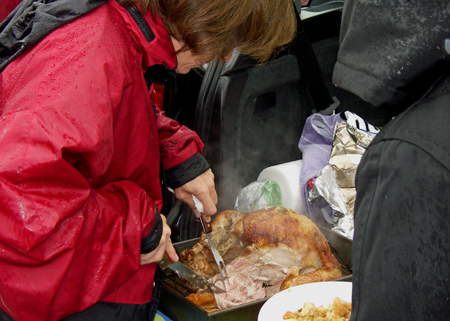
All manner of food was cooked and consumed in the parking lot along with sufficient quality of suitable beverages.  Our tailgate group dinned on a full turkey dinner complete with brussel sprouts (which I actually like), stuffing and potatoes.  A few glasses of red wine washed the meal down perfectly.  

Nothing beats a full course turkey dinner before a football game!
The game itself was great as the Niners finally won their first game of the season 17-9.  It rained through most of the tailgate party and first half so the ponchos we picked up on our drive proved wise to say the least.

We finally won!
I flew home the next morning after a tour of Bill’s home town San Francisco and a wonderful dinner on world famous Fisherman’s Wharf.  It was a whirlwind trip but well worth the investment.  I can’t wait to return in 2011!

Sunday, October 10, 2010

Fall Paradox

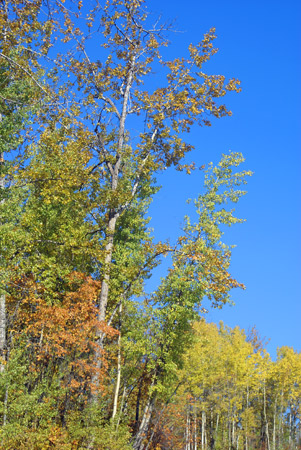
For me the fall season is a paradox.  Mother Nature takes out her paint brush decorating trees with beautiful yellows, oranges and reds all contrasted against magnificent deep blue skies.  At the same time fish sensing the onslaught of winter cruise the shallows consuming just about everything they come across.  The days are numbered.  In north central Alberta any warm days we get after Halloween are a blessing.  Trout and some of the largest pike of the season are on my radar.  I will be trying to get all fishing I can in before it becomes cold, white and hard again. As Charles Dickens once wrote, “It was the best of times, it was the worst of times.”

Fall colors are spectacular
In late September I wrapped up my final shoot for The New Fly Fisher on the North Saskatchewan River near my home in the Edmonton area chasing pike, walleye and goldeye with Keith Rae from Get Hooked Adventures.  The weather was spectacular as the fall colors were just beginning to manipulate the landscape.

A definite no fingers zone!
Navigating the river via Keith’s comfortable jet boat we tossed streamers on sinking lines along the current edges for walleye and goldeye and in the slower reaches floating lines and large flies pulled some large 35-inch and longer pike.  The savage grab of a pike on the fly is addictive and I recommend everyone give it a try.

Keith Rae and I enjoying fly fishing for Pike on the North Saskatchewan
At the same time water boatman and backswimmers begin their annual mating and migration flights.  These insects become active in the mid to late afternoon when the sun’s rays warm the shallows and get them going.  I spent a day on a local lake.  Fishing began slow and sporadic at best.  Random acts of kindness if you will.  About four o’clock we began to see the first aggressive swirls of the day.  Fish were working in and along the deep edge of the weed beds targeting backswimmers as they left the water and when they returned.  Casting foam bodied Ultimate Boatman on hover and floating lines was spectacular.


A fat fall rainbow taken on an Ultimate Boatman

Throat pump analysis revealed backwimmers were on the menu
Takes often came as the fly landed, its arrival.  I recall one large trout that took my fly in a graceful but aggressive porpoise rise.  If the fly isn’t taken upon landing or on the drop a brisk hand twist or 4-5 strip retrieve typically garners a strong response.  Large trout hooked in water less than five feet deep often go berserk.  When the ‘fall’ is in full swing boatman and back swimmer patterns offer some of the most memorable fishing of the season.

I had the chance to check out Stoney Lake before the students arrived
The first weekend in October saw me at Stoney Lake Lodge in British Columbia.  Good friend Brian Chan and I put on our first Learning with the Pros-Advanced session in partnership with B.C. Outdoors Sports Fishing magazine.  Fourteen ardent fly fishers joined Brian, Editor Mike Mitchell and I.  Some of the students came from as far away as Ontario and Wisconsin!  Both the weather and fish cooperated as students spent time on the water with Brian and I after each mornings seminars.  Boatman, , backswimmer, leech, dragon nymph patterns and Boobies all took their share of fish.  From the feedback we received everyone enjoyed their experience and the accommodation and food was fantastic.  Saturday nights prime rib dinner was one of the most memorable feasts I have ever experienced.

After the weekend school I stuck around for a couple of days and filmed two episodes for BC Outdoors Sports Fishing new television show.  This new show begins airing later on this fall on WFN and a number of B.C. networks. 

So if you can get out this fall and experience some fishing for yourself, it won’t be long before the winter is upon us.  Our memories will be the only things left to carry us through the cold months and at the fly tying station.

Sunday, September 26, 2010

Terrestrials and Gulpers in Big Sky Country

Just over a week ago I found myself in West Yellowstone Montana to film two episodes of The New Fly Fisher.  We based ourselves out of the luxurious Hibernation Station a unique complex of log homes nestled right in West Yellowstone.

A few of the Cabins at the Hibernation Station
For me it was a dream come true to have the asphalt of West Yellowstone beneath my feet.  Within an hour’s drive of this small town located on the western approaches to Yellowstone National park are countless rivers and a number of renowned stillwaters.  Rivers such as the Gallatin where a River Runs Through It was filmed, the Firehole, Madison, Slough Creek even the famed Henry’s Fork drew mention on the town’s fly shop report boards.

The West Yellowstone region offers spectacular scenery
We spent the first two days of our adventure filming with fly fishing icon Bob Jacklin.  Bob has been based out of Montana for over 40 years and few know the nearby rivers as well as he does.  Bob’s store, Jacklin's Fly Shop is one of seven fly shops located within this beautiful small town.  It was an honor to share the water with Bob, his casting prowess alone was something to behold.

It was an honor to share the water and swap stories with Bob
The weather was during our stay was, for the most part, spectacular, cool in the morning and close to 70F in the afternoon.  The focus of our filming during the first portion of our trip was on fall terrestrial fishing.  Grasshoppers were active and during our first day’s filming we saw countless numbers drifting downstream.  Many disappeared in large confident rises.  My first Montana trout proved a dream sequence of sorts.  Bob directed me to crawl on my knees upstream to a large bend.  Camouflaged in the grass I dropped my hopper into the main flow that cut diagonally across the run and pushed against the far bank.  My hopper drifted all of three feet when a large set of lips poked through enveloping my hopper and dragging it below.  Fifteen minutes later, after a spirited battle, the 20-inch brown lay in the net ready to pose for the camera.  We admired and released the fish my only regret was not getting a still shot.  We did how ever get the entire take on film so you and I will both have to wait until the show is aired to see it.  During the day we also took other fish including good numbers of lager Rocky Mountain whitefish.  Typically bottom feeders the whitefish rose freely to hoppers.  Due to their under slung mouths their rises were splashy and clumsy.  Not the refined sip synonymous of a brown or rainbow.  I did well hanging my small Stillwater Baetis nymph below my hopper taking a number of good sized whitefish.

Bob releases a hopper caught Rocky Mountain whitefish

The next day Bob took us to the Madison where it flowed between Hebgen and Quake Lakes.  This stretch was what I expected the Madison to look like, not the gentle meadow stream section Bob had us on the day before.  Fishing was not as good but we still did OK.  We managed to film a number of casting and instructional segments.  I also made a point of turning over a number of the larger rocks in the riffles.  The number and size of the large Pteronarcys nymphs I found was staggering along with Hydropsyche caddis.  Some of the Pteronarcys nymphs were as long as my index finger!  It was easy to see why trout in the Madison and many of the other blue ribbon waters in the area are conditioned to look up.  The region is a dry fly fisher’s paradise.

Pteronarcys nymphs from the Madison
The best fishing took place in the afternoon and into the evening so this gave my cameraman Jeremy and I lots of time in the morning to shoot scenic footage and visit some of the area attractions.  Ironically, because we didn’t have permits to film we did not visit Yellowstone National Park.  We did however visit the Grizzly and Wolf Discovery Center.   As listed on their website the center’s mission, “Is to provide visitors to the Yellowstone area an opportunity to observe, learn and appreciate grizzly bears and gray wolves.”  We were able to film large grizzly bears and wolves in their large open area pens.  One of the center’s programs I found interesting was their bear proof container certification process. If a container can last 60-90 minutes in the bear enclosure it is considered certified.  During our visit we were shown a number beaten and battered containers that didn’t all pass muster.  Our visit was one of my personal highlights and I recommend anyone visiting West Yellowstone make time for a visit on their trip planner.  Both grizzly bears and wolves are likely to be seen during your stay and having an awareness of these impressive animals is highly recommended.  We saw a number of wolf and bear tracks along the river and one evening returning home we rounded the corner to see the large brown butt of a grizzly bear crashing through the woods to safety.

Grizzly bears abound in the West Yellowstone region
The second half of our stay saw us on Hebgen Lake targeting the gulping rainbow and brown trout this lake is famous for.  We based ourselves out of the Firehole Ranch for our two days filming.  Firehole Ranch managers Mark Parlett and his wife Kim were unbelievable hosts and Josh Duchateau our guide was a fellow stillwater addict like myself and just fun to be with.  Hebgen is known for its Callibaetis, chironomid, caddis and damsel emergences as are other lakes.  What makes Hebgen so special is the consistent dry fly fishing.  No where else I have fished have I seen fish up on top like on Hebgen.  If the wind wasn’t up pods of fish cruised the shallows ‘gulping’ Callibaetis spinners, duns, damsel adults and terrestrials.  As trout take your fly they make an audible gulp that is quite distinctive.  I did well using a simple winged foam ant casting both to the rise and in front of fish moving in a predictable rise pattern.  Josh took a number of quality fish using a damsel adult.  We didn’t hit Hebgen at its peak as the hatch was winding down and the wind always seemed to follow us.  August is apparently unreal and I am already making plans to return in 2011.  Perhaps even to do a stillwater seminar on Hebgen so if you are interested please let me know or stay tuned to my website and Facebook page.  Other world famous lakes in the region well worth a visit include Quake Lake and Island Park Reservoir and Henry’s Lake in nearby Idaho.

Our guide Josh with a 'gulper' brown from Hebgen Lake
If you ever have the opportunity to visit the West Yellowstone area, do it.  The only challenge would be not spending your entire time on one water or one section of that water.  I am looking at taking two weeks to explore the regions lakes and rivers and making sure I take the time to visit Yellowstone National Park.  Of course it wouldn’t be right not to wet a line in one of the park’s rivers and streams as well!

Yellowstone National Park is literally across the street from West Yellowstone
If you want to see additional images from my stay please visit my Montana album set up on both my personal Facebook page and The New Fly Fisher’s page.

Wednesday, September 8, 2010

Prowling the Parklands-Fall Report

This past Labor Day weekend found me once again prowling the productive stillwaters of the Parkland's region of southwest Manitoba.  As with the spring, I led a group of nine enthusiastic fly fishers, most of which had only heard about the stillwater riches this region has to offer. Bob and Karen Vanderwater worked with me once again helping coordinate this event.  Their help and support is invaluable and provides an element of polish to the whole trip.  

Twin Lake Tigers, just one of the Parkand's stillwater attractions

We based ourselves out of the Barn in the Bush located at the southern end of Lake of the Prairies.  Barn in the Bush, as its name would suggest, is a refurbished barn converted into squeaky clean comfortable living quarters.  All of the lakes we visited on this trip, Tokaryk, Patterson and Twin were roughly an hour away.  Owners Steve and Betty Morris provided wonderful accommodations and put up with our early morning convoys to the various lakes.  If you are looking for great accommodation complete with queen size beds, kitchenettes, individual washrooms and showers in each room then Barn in the Box is the place to be.  It was the perfect base for our group.

Barn in the Bush provides great accommodation

Day one began bright and early with a large bacon and egg breakfast.  Lunches were made and we were soon on our way to Tokaryk Lake near the town of Oakburn.  Those of us within our group who had fished Tokaryk in the spring were full of anticipation. Tokaryk had been spectacular in June, both in average fish size and quantity.  This time fishing was a bit tougher as the region was just recovering from a bout of unsettled weather.  We did not get into the numbers we had originally hoped for but the size and quality of the fight was as we remembered.  A variety of patterns produced fish for most of the group including leeches, dragon nymphs and flashback bead head Pheasant Tail nymphs.  Although it was early fall I took all of my fish on chironomid pupa patterns.  By the fall stillwater trout have typically seen so many chironomid pupa over the course of the season that they respond to a properly presented pattern in an almost Pavlovian fashion.

Tokaryk rainbows still like chironomids

The next day we visited Patterson Lake, a mere stone’s throw from Tokaryk.  Patterson is a large trophy lake containing browns and rainbows.  Typically this lake challenges the fly fisher but every time the line locks up or the indicator plunges beneath the surface chances are it is going to be a big fish.  Today was no exception.  The day was sunny and pleasant but the wind was blowing from the east, a precursor to changing weather.  I expected tough fishing.  One of the students, Mike joined me for the first two hours and was into fish almost immediately on a balanced leech.  This fish managed to wrap the line around both the bow anchor rope and electric motor.  However, with some creative ‘gymnastics’ and teamwork we were able to free the line and land a nice fish.   Two other students Rob and Gerald joined me later in the day catching some of the largest fish of their lives.

Gerald's first Patterson brown

Bob and Karen began at their usual spot near the beaver lodge on the southeast end of the island but soon moved through the narrows and into the bay on the island’s north side to get out of the persistent easterly wind.  Taking advantage of the wind lane that formed downwind of the ‘narrows’ they did well hanging flashback bead head Pheasant Tails beneath an indicator.  Soon the rest of the group gathered there and I experienced one of my best days on Patterson.  A flashback Pheasant Tail on the point and a small #14 boatman dropper produced consistently.  The waters were alive with immature fat head minnow fry and the flashback Pheasant Tail did a great job suggesting them.  Throat samples revealed minnow remnants and tiny water boatman.  As the day wore on a few browns trickled into the mix and both Karen and I managed to wrestle a few Patterson residents.

Patterson browns are big and fat

Two members of our group, Doug and Rick, supported by a desire to explore and a well charged battery explored the far end of Patterson and had a fantastic day.  Doug took the largest fish of the trip, a magnificent 28 inch rainbow.

Now that's a rainbow!

It was a great day, all of us were glowing from the bright sun and the numbers of fish we had caught and released, a true testimony to the quality of the Parkland's area lakes.

Twin Lakes tigers like foam boatman and back swimmer patterns

Our final day found us hunting for tiger trout on Twin Lakes located a short drive north of Roblin.  Twin is a catch and release fishery full of large aggressive tiger trout.  The day however started slowly.  A large low pressure system had swept up from Montana and blanketed Saskatchewan and south western Manitoba.  The normally cooperative tiger trout weren’t willing to play right away.  By midday most had yet to dance with a tiger.  I was fortunate to land one on an Ultimate Boatman cast tight to the shoreline tules.  In the early afternoon fortunes began to change.  Doug figured things out by casting tight to the tules with a variety of boatman patterns, managing to land over a dozen tigers.

Steve and Betty admire a Twin Lakes tiger

During the previous nights session I provided the group with an overview of Twin and made a point of mentioning a tiger trout’s willingness to come to the surface.  Doug soon switched from his boatman patterns to a large Chernobyl Ant and continued to take large tigers on the surface.
 
Twin Lakes tiger returns to its haunt

Foam based boatman and back swimmer patterns were the patterns of choice as their buoyant nature was perfect for the shallows when used in conjunction with a clear AquaLux line.  On many occasions I would make a cast and a tiger would roll aggressively where my fly landed.  From time to time I thought the tiger had rolled on a natural boatman and as I stripped to cast and cover the rise I soon found out that the rise was actually to my fly. The take had not had time to transmit down the fly line.  Casting into gaps and channels in the tules was the winning ticket as tigers cruised in water barely deep enough to cover their backs.  This is a common sight during the fall period as trout stocking up for the long winter ahead prowl the shallows eating just about anything they come across.

Mike enjoying his Parkland experience

Our Twin Lakes adventure was the perfect cap to another superb trip.  Everyone in the group was beaming from their experiences over the weekend.  We are already working on a larger scale trip in June of 2011.  The June trip will offer the choice of a four day trip straddled over a weekend and a longer Tuesday to Sunday excursion.  Amongst the trip curriculum I will once again be providing a series of stillwater lectures, daily de-briefs and focused one on one time with each student to ensure maximum learning and the most rewarding experience possible.  If this sounds like something you would like to experience please let me know.  I will be putting a course handout together shortly.  By preliminary interest we have already received these trips will sell-out in short order. 

For more information and images from our trip please drop by my Facebook page and read Bob and Karen’s report on the Central Alberta Fly Tyers Blog.


Tuesday, August 24, 2010

The Wet Fly Swing

This past week I rounded out my Newfoundland/Labrador trip at Tuckamore Lodge located near Main Brook on the eastern shore of the northern peninsula.  I was there filming another episode of The New Fly Fisher featuring Atlantic salmon.

The drive from Deer Lake to Tuckamore Lodge is scenic

Tuckamore Lodge is a luxurious four star destination that is popular not only with fly fishers but hunters during the fall months.  The food and accommodation was outstanding.  While we were there each evening saw a different group at dinner as tourists traveling Newfoundland used Tuckamore as a rest stop during their travels.

Tuckamore Lodge provides luxurious four star accommodation and food

The area offers lots of tourism opportunities including whale watching, ice berg tours and cultural tours including L'Anse aux Meadows, North America's only authenticated Norse settlement.  A visit to Tuckamore’s website details a host of opportunities to experience.


The region, like most of Newfoundland is home to a dense moose population.  These huge animals are a common site along the road side and caution should be exercised when traveling in the early morning or evening.  High speed night travel is not recommended as these animals cause serious damage and injury should you collide with one.

Newfoundland and the region around Tuckamore in particular is home to countless moose

As for the fishing our schedule had us there at the tail end of the season.  Waters were beginning to drop and temperatures where beginning to rise, close to 70F in some stretches.  The salmon had been in the river for a while and where becoming more focused on their reproductive task at hand than chasing our flies.  When Atlantic’s are active the traditional methods involve either a dead drifted dry fly or riffle hitched wet fly.  Both of these presentation styles are predicated on taking advantage of a fresh salmon’s aggressive nature.  We did have some success with the dead drifted dry fly.  A White Wulff was particularly effective as was the reliable Bomber.  The trick with the dry fly was to repeatedly cover an area known to be holding salmon.  Short 6-8 foot drifts over a particular stretch worked better than trying for the world’s longest drag free drift.  My cameraman James was quick to adapt. It took me a while to accept this approach as I always aim for long drag free drifts when using dry flies.


But as our week progressed our dry fly success dwindled.  We resorted to a traditional method, the wet fly swing.  Our challenge was getting the fly down to the fish.  In Newfoundland and Labrador you are only allowed to use un-weighted flies and floating lines.  Strike indicators are also a no no. 

I switched to an Steelhead/Salmon Fluorocarbon leader to help get the fly down and a larger #6 sparsely dressed dark fly such as a Blue Charm.  This combination offered me the best chance to get my fly down in the water column to where the fish were holding.  We could see them from time to time flashing in the run and of course the odd rise or jump really helped!  Atlantic salmon also love to hold in front of large rocks.  A trait learned early in life as we observed parr holding in front of rocks beside us in the runs were fishing on the Salmon River.

Atlantic salmon parr learn early on about the value of holding in front of boulders

I placed a cross current reach cast and added additional mends, typically upstream, to help sink the fly.  As the line and fly drifted downstream the takes typically occurred in the lower quarter when the fly was at its deepest just before starting its cross current swing as it came under tension.  Takes were very subtle.  I recall one where I only saw the tip of the fly line move suspiciously upstream.  I struck more out of instinct.  The water erupted. A large salmon went airborne immediately.  They aren’t known as the ‘leaper’ for nothing.  Two cartwheel jumps were followed by an energetic sprint down stream.  Within seconds it was over.  I swear the fish turned its head back toward me and spat the fly out complete with a look of disgust.  Oh well, better to have loved and lost than never to have loved at all!

A grilse that feel to a swung Blue Charm

I managed to persevere and land fish and we will have some great footage for an informative educational show The New Fly Fisher is known for.  In the future I will make a point of visiting Newfoundland Labrador in July when the runs are at their peak!

Wednesday, August 18, 2010

Labrador Atlantic's

This past week found me in Labrador chasing Atlantic salmon for the first time as I filmed an episode of The New Fly Fisher.  I have caught all five species of Pacific salmon and steelhead on the fly.  The chance to exchange blows with Atlantic salmon was too good to pass up.  Landing one would complete my list of anadromous salmonids on the fly.

The view downstream from the spectacular Forteau Falls

During my week long visit I stayed at the Labrador Salmon and Lucky Strike lodges courtesy of new owner Paul-Amie Joncas.  We began filming at the Labrador Salmon Lodge fishing the Forteau River.  Labrador Salmon Lodge is a very comfortable facility with a traditional cozy feel to it.  The food was fantastic and provided much need fuel for our treks up and down the banks of the Forteau River.  The scallop savichy was perhaps my favorite.  Served on the half shell they just melted in my mouth!

 
From left to right; Armand, James, myself, George, Dawn and Herman

James, my cameraman and I were joined by four other fly fishers, Armand (Paul Aime’s brother) his friend Herman, George and Dawn.  Together we hit it off immediately and our trip was filled with good hearted banter, laughter and new found friendship.  James and I managed to defend our ‘mainlanders’ honor over a five game crib tourney with Newfoundlanders George and Dawn.  I am fortunate to have made five new friends from my Labrador experience.

Our trip for both lodges was at the tail end of the season, peak season on most Atlantic salmon rivers in Labrador and Newfoundland.  Atlantic's were still in the river but they had lost some of their aggressive tendencies and were beginning to focus on their primary reason for being there, reproduction.  July apparently was one of the most memorable on record with numerous reports of high catch rates and some large fish. 

During my two and half days on the Forteau I managed to hook five fish.  All on dead drifted dry flies, a favorite method for many, myself included!  Of the fish I hooked, including a chrome bullet we estimated well over 10 pounds on the first morning.  Unfortunately I was not able to land any salmon.  Three where lost right at my boot laces.  The common practice is to use a glove to tail the fish to minimize any risk of injury from a traditional knotted landing net.  While I understand some of the reasoning behind this practice I know that if we had a good quality catch and release net we would have landed all three fish.  Successfully tailing a large spirited Atlantic requires delicate fish fighting to tire the fish enough to grab them.  I personally believe that using a proper catch and release net would result in less stress to the fish as the fighting time would be less.


The Blue Charm hair wing, a Labrador favorite

While on the Forteau my guide Cecil provide comprehensive lessons on how to properly swing wet flies using a riffle hitch.  The riffle hitch places two half hitches behind and under the hook eye at the rear of the fly’s head.  The hitches cause the fly to plane and wake at the surface when swung under tension.  It is heart stopping to watch the wake of a large Atlantic salmon pursue the fly as it swings across a run.  I had a few ‘chasers’ but none resulted in hook ups.

Half way through our week long trip we drove up the Labrador coast to the Lucky Strike Lodge based a short drive from the Pinware River.  As with Labrador Salmon Lodge the accommodations at Lucky Strike were very comfortable and a welcome sight at the end of a day’s fishing.


The Pinware River, big rugged water

The Pinware is a completely different river to the smaller gentler Forteau River.  Rugged and fast, the boulder strewn Pinware is home to some huge salmon.  Humping camera gear up and down its steep banks along its rocky shorelines burned more than a few calories.  A good thing as our fantastic cuisine followed us as well.    Gorging on fresh Atlantic lobster is a treat I seldom pass up. We went up and down one stretch affectionately called ‘Heart Attack Hill’.  A fact I didn’t learn until the trip was complete.


James works Chute Pool

The Pinware is home to the legendary Chute Pool, a huge expanse of water beneath a large waterfall that holds large numbers of Atlantic salmon.  As with the Forteau, dead drifting dry flies such as spun deer hair Bombers and Bugs and hitching hair wing wet flies was standard practice.  I was amazed that Atlantic salmon would rise up from the depths of Chute Pool to pluck dry flies floating amongst the foam the falls produced.  The rise of a large Atlantic is as delicate as a trout rise and is easily confused with the large numbers of aggressive parr that are maturing in the river.  I soon learned to strike at anything as I missed some large fish during my first hours on the Forteau earlier in the week passing them off as tiny salmon parr not worth setting on.  Another lesson involved knowing where Atlantic salmon prefer to hold, in front of large boulders protected by the hydro-dynamic cushion the flow creates as it splits around a rock.

On my first day on the Pinware I had a couple of rises that I missed and I hooked two fish riffle hitching a #8 Blue Charm.  As with the Forteau, I lost another fish in the shallows as it came unbuttoned while we attempted to tail the fish.  I was beginning to wonder if we would be able to land a fish for the camera.  We had some great takes on both rivers along with cart wheeling salmon but we needed something in our hands to provide closure.  We were down to our last day.


A Humpback sounds
In the summer months whale sightings along the Labrador coast are common

As we ate dinner James and I discussed the plans for the next day.  Paul-Aime told us that whales were close to shore and he had made plans for us to do a little whale watching.  Large humpbacks and bottlenose dolphins worked as a team herding capelin, a small smelt-like fish.  It was an impressive sight as humpbacks in excess of 40 feet passed with yards of our boat.  The dolphins zoomed past us in groups of 5-10.  We estimated that there were five humpbacks and well over 20 dolphins working around us.  Humpbacks are great to film as they dive elegantly, bodies arched and huge tail flukes almost waving good bye.  It was an awesome humbling experience.


Bombers and Bugs, a must for any Atlantic salmon fly box

The next morning we scrambled over the large boulders and rock edges up to Chute Pool to try our luck once again.  I chose my 10 foot seven weight Sage SLT as it was already strung up with a large #6 orange Bomber.  My guide Dennis positioned me so I could cover the large boulder that the water leaving Chute Pool rushed over.  I had made probably half a dozen casts when I had a rise to the fly.  I was too quick and missed the hook up.  Thankfully I didn’t stick the fish.  I knew if I placed the fly back in harms way the salmon would probably return.  A few casts later the fish rose.  Once again I was premature.  It is common for an interested fish to rise repeatedly, Atlantic salmon are that aggressive.  I continued casting and as the fly approached the leading edge of the boulder the fish rose again.  This time I delayed my response, I managed to drive the orange Bomber home.  The fish surged upstream, hidden beneath the surface.  As it started to run I realized that I had the drag on my Islander locked down.  I had to back off the drag fast or I was going to break the fish off before the fight started.  In my excitement gave the drag knob such a hard twist I now had hardly any drag at all.  My reel overran and I had to put my head down, hold the fish tight by pinching the line against the cork handle and get my reel ready for the fight.  During this time the fish jumped.  I did not see it as I was preoccupied with getting my line under control.  All I heard Dennis say, “That’s a big fish!”


Chute Pool is a vast expanse of water
With the reel now under control I gathered the loose line, and got the fish onto the reel as fast as I could.  The power of the fish was incredible and it became obvious that I would not be able to contain this fish within Chute Pool.  Within seconds the fish shot downstream through the chute at the end of pool and into a large run known as the ‘Black Hole’.  Line and backing pealed off in short order.  Rod held high to avoid the midstream boulders I jumped and hopped across boulders the size of cars and trucks I had cautiously navigated minutes before as I scrambled into position.  Now in position on a huge boulder at the head of Black Hole Dennis directed me to hold my ground and stop the fish from running, easier said than done.  The long rod proved its worth as I was able to keep the line high and avoid catching the line or sawing the leader on the ragged edge of a boulder.  The salmon and I began an exhaustive tug of war.  It ran into my backing three times, cart wheeled at least 3-4 times and ran across the run at least twice.  My forearms were on fire, I felt for sure I would never see this fish.  But as the battle wore on I began to gain the upper hand.  Dennis had jumped down into a calm stretch of the pool and after a few anxious moments tailed the fish.  I passed the rod onto the other members of my group who had gathered to watch the fight and jumped down to my waiting prize.

What a fish!

It was a magnificent fish, silver bright with a pearlescent blue iridescent stripe running along its sides that I will never forget.  As I held it in my hands we measured the fish, 34 inches and an estimated 15 pounds.  My heart was beating like a hamster.  My first Atlantic on the fly and it was a prize.  James my cameraman followed the battle throughout hopping about the rocks with the camera.  He recorded it all, in his words it was, “Epic!”  I can’t wait to see the footage.  It gave the show the explosive closure we needed.  What a fish!