Showing posts with label Stillwater Seminars. Show all posts

Wednesday, June 27, 2012

Naked In Utah

For me, blogs seem like feast or famine.  During the off season things seem far less hectic.  Although I am typically speaking at shows and clubs the pace doesn’t seem nearly as crazy as the open water season.  During the off season I am subsequently able to keep up with my goings on and lessons learned.  Now I am just updating you on events that happened just over a month ago.

Falcon's Ledge Greetings Cards Await Every Guest

On the weekend of May 18-20th I was once again in Utah at Falcon’s Ledge for another of my stillwater schools.  The weather was fantastic, a far cry from the typically unsettled spring of western Canada. Due to flight delays I arrived late in the evening.  Luxurious accommodations, a Falcon’s Ledge standard, awaited.  All guests are greeted by a thoughtful welcome card.  This year mine had a slight twist as it also included birthday wishes.  I was thoroughly impressed.  Dave, Spencer, Grant and the rest of the Falcon’s Ledge staff had taken the time to learn my birthday would be on May 19th.  It is easy to see why Falcon’s Ledge is so highly regarded within the Orvis Endorsed Lodge Program and why they are proud recipients of the Orvis Endorsed Fly Fishing Lodge of the Year for 2012.  And yes, birthday cake was provided putting the icing on the cake, pun intended, for my trip.  The diet crashed in flames once again!

Callibaetis Nymphs Were on the Menu

Callibaetis and damsels were active on the lodge lakes.  My Herl May was a trout favorite on every lake that weekend.  Falcon’s Ledge guide and friend, Grant Bench and I were busy every evening replenishing lost flies for everyone.

With each on the water seminar a specific opportunity or presentation technique typically steps to the front.  This time the Callibaetis and damsel activity provided the perfect recipe for the naked technique-floating lines coupled with long, 15 feet or greater leaders.


A Falcon's Ledge Rainbow Taken Using the Naked Technique (Photo Courtesy of Spencer Higa)

Floating lines and strike indicators dominate stillwater fly fishing today. I use them often.  And for good reason as it can be a deadly method.  But there are other presentation techniques such as the naked technique all stillwater fly fishers should learn.  There is more to fly fishing lakes than hanging flies under indicators.

Watching Students Enjoy Their Own Success Adds to my Enjoyment
(Photo Courtesy of Spencer Higa)
Nicknamed for its lack of an indicator, the naked technique is the traditional method I learned to fish chironomid pupa and larva (bloodworm). Strike indicators didn’t exist.  I firmly believe all stillwater fly fishers should learn how to fish flies using a floating line and long leader as it teaches two critical stillwater skills, patience and touch.  Skills, that once developed, improve all aspects of your stillwater presentation.

When fishing the naked technique I use either Rio’s Indicator or Rio Grand lines.  The large head profile of these lines is perfectly suited for casting long leaders.  A Rio Indicator leader forms a critical foundation of my long leaders.  This leader features a short .022” butt section that tapers down to the thin tippet section in less than three feet.  Most tapered leaders feature a butt section that is usually about 50% of the leader for turning over dry flies.  I want a leader system with a stiff butt section to aid turnover and long tippet section to sink flies quickly.
 
For my long leaders I begin with approximately three feet of butt section that is just thicker than the butt section of the Indicator leader.  The butt section is attached to the slender line loop via a clinch knot. I then attach the 10 foot Indicator leader using a blood knot as this provides a smooth horizontal profile that travels through the guides easily.  To complete the over leader length I simply add Flouroflex Plus fluorocarbon tippet using a triple surgeon’s knot.  The leader has to be 25% longer than the water is deep as the leader doesn’t sink straight off the end of the fly line.  So to fish 16 feet down for example,  requires a 19 foot leader.

Using fly lines such as the Rio Grand eases casting long leaders.  Keep your false casts to a minimum, break your wrist slightly to facilitate an open loop and remember the properties of a weight forward line. Shoot the line to the target.  I never false cast more than twice.  Repeated false casts are asking for tangles.  As the line shoots out and reaches the end of the cast let the line shoot tight to the reel or pinch it to a stop.  This causes the flies to slingshot over aiding leader turnover.  Get in the habit of looking for distinct splashes when fishing multiple flies.  If they land within close proximity to each other strip them in and investigate as you probably have the makings of a tangle.  When using multiple flies I keep them 3-5 feet apart depending on water clarity, the clearer the water the greater the separation.  This slingshot technique also works well with indicators.

Spencer Showing Me a Book I should Read!

Once the line hits the water strip out any slack and let the flies sink.  Thirty seconds is standard.  Use your watch to ensure accuracy.  For many waiting 30 seconds is agony.  Remember the patience by product of this method.  Once sunk use two brisk 3-inch strips to remove any slack and perhaps draw a nearby fish to the fly.  If there are no takers begin a slow, and I mean slow, handtwist retrieve.  During the retrieve there must be no surface wake caused by the fly line, more agony for the impatient.

Using Floating Lines Coupled with Long Leaders is my Favorite Method for Fly Fishing Lakes
(Photo Courtesy of Spencer Higa)

Complete line control is critical when using the naked technique.  This means double anchoring when fishing from a boat or pontoon boat.  You must turn your watercraft into essentially dry land.  Any sway means loss of line control and retrieve.  You have to stay tight to the flies to be successful. 
Your fly line is a 90 foot strike indicator.  Watch it like a hawk for signs of a take, particularly the tip region closest to the fly.  If the line veers left right or down raise the rod to set the hook.  If there is a little squiggle in the fly watch it closely.  If it suddenly straightens raise the rod.  In calm conditions you will see takes before you feel them.  The elevated banks of many of the Falcon’s Ledge lakes provided a perfect vantage point when I demonstrated the method.  Students saw the line move as fish inhaled the fly below.  I couldn’t have asked for a better demonstration.  To drive my point home on two occasions during my presentation I hooked and landed two fish twice.

Falcon's Ledge Friends, Spencer Higa (Left) and Grant Bench (Right)

If I were limited to once presentation technique for lakes it would be without a doubt be fishing floating lines and long leaders, particularly if I am working water between 14-18 feet where this method shines. I have provided the Reader’s Digest version of the naked technique and it is often requested at just about everyone of my stillwater seminars.  I encourage you to give the naked technique a try or better yet join me at on one of my stillwater seminars.  I am already working with Dave and Spencer about putting another school at Falcon’s Ledge. Space is still available for my upcoming schools on Fortress Lake and this fall in Manitoba.  Check out my website calendar for all the details.


Friday, March 9, 2012

Join Me This Season

Earlier this week I completed a journey that began with one of those white knuckle blowing snow limited to no visibility drives.  The kind of trip that starts safe and sound.   But when you are almost in the exact geographical center between home and your destination Mother Nature batters you with a vengeance.  While focusing on the task at hand, driving, and making sure that the taillights I am following aren’t disappearing to some off road, in the ditch, destination thoughts of being somewhere else such as on the water crossed my mind often.

Can you say fun drive!
I enjoying providing stillwater workshops and seminars across North America including many of the ‘on the water’ variety.  Each year around Christmas I post the seminars and workshops I am aware of up on my website calendar.  In the past I have had people express disappointment that they weren’t aware of my seminars or just forgot to check back on my calendar.  In order to alleviate any missed opportunties here are the workshops and seminars in chronological order I have planned for 2012.

Made it to my first destination
I have included a brief description of each seminar, pricing, dates etc.  In addition, I have provided links to specific websites or informational documentation for each course.  If any one of these seminars or workshops is of interest please let me know right away as many of them feature small class sizes for maximum interaction and learning.  If you check my calendar you will see that a number of workshops and seminars have already sold out.

Stillwater Secrets and Beyond Seminar, Ottawa Ontario, March 17-18, 2012-
This is a two day seminar consisting of a full day seminar on Saturday including a variety of stillwater techniques, hands on knot tying and Euro nymphing.  Sunday features a hands on fly tying seminar with all materials provided less basic tying tools and some spooled products such as thread, Mylar and wire.  Costs are $50/day or $90 for both days.  There are still a few spots available, please send me and email to book your spot.

Conquering Chironomids Weekend Seminar, Robinson’s Sporting Goods, Victoria, B.C, March 31-April 1, 2012.-This comprehensive 2-day seminar covers both tactical stillwater chironomid presentation techniques and hands on fly tying.  The presentation techniques seminar takes place on Saturday, hands on fly tying Sunday.  All tying materials less basic tying tools and spooled products such as thread Mylar and wire are included.  Costs are $40/day or $75 for both days.  To book a spot please contact Robinson’s Sporting Goods, 1-888-317-0033.

BC Outdoors Sports Fishing Learning with the Pros Seminar and Workshop with Brian Chan, Kelowna B.C., April 28-29, 2012.-
The Learning with the Pros seminar format has been a popular choice for many.  Good friend and colleague Brian Chan and I will be providing a one day techniques seminar followed by an all-day hands on tying seminar.  The tying seminar includes all materials less basic tying tools and spooled products such as Mylar, thread and wire.  Costs are $100/day or $180 for both days.  To book a spot please contact Kim Crawford at B.C. Outdoors Magazine, 604-464-1876 or via email.

Spectacular food and accomodation along with access to a number of private lakes awaits those who visit Falcon's Ledge
Stillwater Fly Fishing School, Falcon's Ledge, Altamont, Utah, Friday, Saturday and Sunday, May 18-20, 2012-This the second season I have offered an on the water stillwater fly fishing school at the luxurious Orvis Endorsed Falcon’s Ledge.  We have access to private waters teaming with rainbows, browns and tiger trout.  This particular seminar will have a definite chironomid, mayfly and damselfly focus.  Class size is limited to 12 students only.  To book a spot please call Falcon’s Ledge at 877-879-3737.  Seminar price includes all food accommodation, class room and on the water instruction.

Conquering Chironomids Fly Fishing School, Fortress Lake Wilderness Retreat, Fortress Lake, B.C., June 18-June 22, 2012-
This weeklong school takes place on one of most spectacular stillwater venues in North America chasing trophy brook trout using a variety of chironomid techniques.  At this time of the year the chironomid hatch on Fortress should be in full swing.  Emerging adults blanket the water like snowflakes.  Fortress Lake provides a rare opportunity to hone a variety of floating and sinking line techniques.  Costs for fly in are $2895 and includes flights from Hinton, AB, food, accommodation, classroom and on the water instruction.  A hike in option priced at $1875 is also available.   To book a spot please contact Fortress Lake Retreat at 403 346 1698 or email.

Henry's Lake Cutthroat
Idaho Stillwater School, Island Park Lodge, Idaho, July 13-14, 2012-The Island Park region offers some outstanding stillwater opportunities.  This comprehensive stillwater school includes one full day on Sheridan Lake.  Sheridan is a private lake trophy lake.  I have personally taken rainbows to 9 pounds.  We will also spend time on legendary Henry’s Lake and Island Park Reservoir.  The school is a blend of both class room and on the water instruction.  At this time of the year, chironomids, mayflies and damselflies should be in full swing.  Costs are $595 and include access to Sheridan Lake.  Accommodation and food is extra.  Class size is limited to 10 sudents only.  To book a spot please contact Lynn Scott at BS Flies via email or call (208) 390-2177.

There are few places as scenic as Fortress Lake
Fortress Lake Sight Fishing School, Fortress Lake Wilderness Retreat, Fortress Lake, B.C., Monday through Friday, August 27-31, 2012-during the late summer Fortress Lake is crystal clear providing some unbelievable sight fishing opportunities.  Watching a trophy brook trout rush and engulf your streamer or delicately rise to a dry fly is heart stopping.  Through both classroom and on the water instruction students will learn a variety of skills such as how to spot and approach fish along with equipment considerations for sight fishing.  This type of fly fishing is addictive so be warned.  Costs for fly in are $2895 and includes flights from Hinton, AB, food, accommodation, classroom and on the water instruction.  A hike in option priced at $1875 is also available.   To book a spot please contact Fortress Lake Retreat at 403 346 1698 or email.

Prowling the Parklands Weekend Stillwater Seminar and Hosted Trip, Russell, Manitoba Region, September 13-17 2012 (three full days on the water) and September 17-23, 2012(five full days on the water)-The southwest corner of Manitoba offers arguably the best stillwater fly fishing in North America.  These rich productive lakes are home to large often huge rainbows, browns and tiger trout.  At this time of the year trout will be gorging on leeches, scuds, water boatman, backswimmers and vast quantities of forage fish.    The three day trip costs $695/person, 5 day trip costs $1150/person and includes accommodation, food, seminars, and one on time with me on the water.  My June trips booked before I had a chance to advertise and fall is already starting to book.  These are popular trips.  To book a spot please contact me via email.

Hopefully you might be able to fit one of my seminars or workshops into your open water schedule.  If you need any further information at all please do not hesitate to contact me via email.

Monday, October 25, 2010

California Trout and Pigskin

I recently returned from a week long speaking and seminar jaunt through Washington and California.  My journey started as Spokane’s Inland Empire Fly Fishing club welcomed me where I presented my Favorite Western Canada Stillwaters program.  This is the second time I have spoken to the Inland Empire club originators of the best selling book Flies of the Northwest.  Bob Harley and the rest of the club members provided an excellent dinner and in addition to my presentation I tied a few of my favorite flies for them as well.  The Inland Empire club is home to Jerry McBride, originator of the balanced fly concept that has changed the way I tie and present many of my patterns.  It was great to see him and thank him personally for his innovative approach to pattern design.
 
After my evening in Spokane I flew out early the next morning carrying on down to Santa Rosa California where I put on my Going Deep-Sinking Line Strategies for Stillwaters presentation to the Russian River Fly Fishers.  Prior to my presentation club member Joe Banovich took me out to a local smorgasbord restaurant for dinner.  What a spread! I gorged myself silly, totally blowing my diet.  I am a sucker for Sushi in particular and they had lots on hand! 

Lake Davis is a beautiful place to drown flies!
After my presentation was complete I immediately headed north to Clio California where I would be putting on a two day stillwater seminar with Bill Forward.  Bill is the Senior Editor with Sierra Fisherman magazine and owner of Forward Bound Guiding and Fly Fishing Instruction.  

Bills beautiful 16' boat, perfect for a day's fishing!
Over the Friday night and Saturday Bill and I provided two days of instruction to 19 enthusiastic students eager to improve their stillwater fly fishing skills.  Students were provided a number of seminars including how to read lakes, equipment requirements for stillwaters, stillwater entomology, presentation skills, and the intricacies of using indicators on lakes.  In addition to the lectures students were given a chance to get on the water and hone their skills.  At the end of the on the water segment of the seminar Bill and I provided a de-briefing as students discussed their successes, setbacks and observations.  This format provides great interaction and arguably provides the greatest learning opportunity.  Feedback has been extremely positive. This was our first seminar and based upon this positive feedback we are already working on plans for additional seminars for 2011.  Stay tuned to my blog, Facebook page and website for additional details once they are figured out.

Pug nosed Lake Davis rainbow
During my stay I had the opportunity to fish Lake Davis, one of northern California’s most well known stillwaters and one of my ‘bucket list’ lakes.  Fishing was steady and despite the slowly deteriorating weather both Bill and I did well.  Trout were cruising high in the water column and small chironomid pupa and flashback gold bead Pheasant Tail Nymphs suspended 3-5 feet down proved deadly.  On the last day in particular I did well presenting my flies within the foam of the wind lanes that began to form in the afternoon.  As with most days the fishing hit a crescendo just as it was time to pull anchors and wrap up our stillwater seminar.   

Hanging flies in and around weed pockets proved productive
Lake Davis is unique as it provides the opportunity to stalk fish from shore.  Fish were in the shoreline shallows, often in barely enough water to cover their backs, rummaging for food.  If your presentation was correct they took dry flies readily.  This phenomenon is rare.  Most lakes don’t allow much wading or stalking opportunities due to back cast issues, shoreline weed growth or soft muddy bottoms that make wading and stalking nasty or in some cases outright dangerous.

The line up to get in the parking lot 2.5 hours before game time!
After winding up the seminar Bill, his wife Carol and I headed south to San Francisco to attend the San Fransico 49rs vs. Oakland Raiders football game.  For those of your familiar with the bay area this game offers an intense rivalry.  This was my first NFL game and as a die hard Niners fan it was the icing on my trip.  We were on our way by 6:00am for the roughly four hour drive arriving at Candlestick Park just after 10:00 for the experience that is tailgating.   

Me in my 'colors'
Bill provided me with a Niners golf shirt and jacket to ensure I had my colors straight.  He toured me around the parking lot as I took in the entire experience, from an inflatable Darth Vader to a big screen TV complete with satellite to watch the early games.   

The tailgating experience

Raider Nation was well represented.
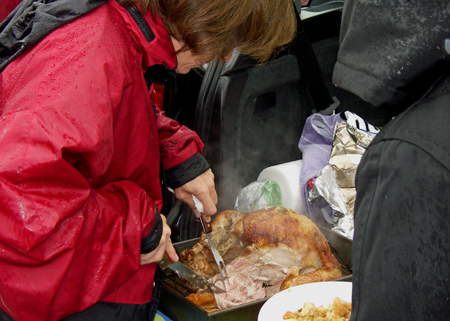
All manner of food was cooked and consumed in the parking lot along with sufficient quality of suitable beverages.  Our tailgate group dinned on a full turkey dinner complete with brussel sprouts (which I actually like), stuffing and potatoes.  A few glasses of red wine washed the meal down perfectly.  

Nothing beats a full course turkey dinner before a football game!
The game itself was great as the Niners finally won their first game of the season 17-9.  It rained through most of the tailgate party and first half so the ponchos we picked up on our drive proved wise to say the least.

We finally won!
I flew home the next morning after a tour of Bill’s home town San Francisco and a wonderful dinner on world famous Fisherman’s Wharf.  It was a whirlwind trip but well worth the investment.  I can’t wait to return in 2011!

Wednesday, September 8, 2010

Prowling the Parklands-Fall Report

This past Labor Day weekend found me once again prowling the productive stillwaters of the Parkland's region of southwest Manitoba.  As with the spring, I led a group of nine enthusiastic fly fishers, most of which had only heard about the stillwater riches this region has to offer. Bob and Karen Vanderwater worked with me once again helping coordinate this event.  Their help and support is invaluable and provides an element of polish to the whole trip.  

Twin Lake Tigers, just one of the Parkand's stillwater attractions

We based ourselves out of the Barn in the Bush located at the southern end of Lake of the Prairies.  Barn in the Bush, as its name would suggest, is a refurbished barn converted into squeaky clean comfortable living quarters.  All of the lakes we visited on this trip, Tokaryk, Patterson and Twin were roughly an hour away.  Owners Steve and Betty Morris provided wonderful accommodations and put up with our early morning convoys to the various lakes.  If you are looking for great accommodation complete with queen size beds, kitchenettes, individual washrooms and showers in each room then Barn in the Box is the place to be.  It was the perfect base for our group.

Barn in the Bush provides great accommodation

Day one began bright and early with a large bacon and egg breakfast.  Lunches were made and we were soon on our way to Tokaryk Lake near the town of Oakburn.  Those of us within our group who had fished Tokaryk in the spring were full of anticipation. Tokaryk had been spectacular in June, both in average fish size and quantity.  This time fishing was a bit tougher as the region was just recovering from a bout of unsettled weather.  We did not get into the numbers we had originally hoped for but the size and quality of the fight was as we remembered.  A variety of patterns produced fish for most of the group including leeches, dragon nymphs and flashback bead head Pheasant Tail nymphs.  Although it was early fall I took all of my fish on chironomid pupa patterns.  By the fall stillwater trout have typically seen so many chironomid pupa over the course of the season that they respond to a properly presented pattern in an almost Pavlovian fashion.

Tokaryk rainbows still like chironomids

The next day we visited Patterson Lake, a mere stone’s throw from Tokaryk.  Patterson is a large trophy lake containing browns and rainbows.  Typically this lake challenges the fly fisher but every time the line locks up or the indicator plunges beneath the surface chances are it is going to be a big fish.  Today was no exception.  The day was sunny and pleasant but the wind was blowing from the east, a precursor to changing weather.  I expected tough fishing.  One of the students, Mike joined me for the first two hours and was into fish almost immediately on a balanced leech.  This fish managed to wrap the line around both the bow anchor rope and electric motor.  However, with some creative ‘gymnastics’ and teamwork we were able to free the line and land a nice fish.   Two other students Rob and Gerald joined me later in the day catching some of the largest fish of their lives.

Gerald's first Patterson brown

Bob and Karen began at their usual spot near the beaver lodge on the southeast end of the island but soon moved through the narrows and into the bay on the island’s north side to get out of the persistent easterly wind.  Taking advantage of the wind lane that formed downwind of the ‘narrows’ they did well hanging flashback bead head Pheasant Tails beneath an indicator.  Soon the rest of the group gathered there and I experienced one of my best days on Patterson.  A flashback Pheasant Tail on the point and a small #14 boatman dropper produced consistently.  The waters were alive with immature fat head minnow fry and the flashback Pheasant Tail did a great job suggesting them.  Throat samples revealed minnow remnants and tiny water boatman.  As the day wore on a few browns trickled into the mix and both Karen and I managed to wrestle a few Patterson residents.

Patterson browns are big and fat

Two members of our group, Doug and Rick, supported by a desire to explore and a well charged battery explored the far end of Patterson and had a fantastic day.  Doug took the largest fish of the trip, a magnificent 28 inch rainbow.

Now that's a rainbow!

It was a great day, all of us were glowing from the bright sun and the numbers of fish we had caught and released, a true testimony to the quality of the Parkland's area lakes.

Twin Lakes tigers like foam boatman and back swimmer patterns

Our final day found us hunting for tiger trout on Twin Lakes located a short drive north of Roblin.  Twin is a catch and release fishery full of large aggressive tiger trout.  The day however started slowly.  A large low pressure system had swept up from Montana and blanketed Saskatchewan and south western Manitoba.  The normally cooperative tiger trout weren’t willing to play right away.  By midday most had yet to dance with a tiger.  I was fortunate to land one on an Ultimate Boatman cast tight to the shoreline tules.  In the early afternoon fortunes began to change.  Doug figured things out by casting tight to the tules with a variety of boatman patterns, managing to land over a dozen tigers.

Steve and Betty admire a Twin Lakes tiger

During the previous nights session I provided the group with an overview of Twin and made a point of mentioning a tiger trout’s willingness to come to the surface.  Doug soon switched from his boatman patterns to a large Chernobyl Ant and continued to take large tigers on the surface.
 
Twin Lakes tiger returns to its haunt

Foam based boatman and back swimmer patterns were the patterns of choice as their buoyant nature was perfect for the shallows when used in conjunction with a clear AquaLux line.  On many occasions I would make a cast and a tiger would roll aggressively where my fly landed.  From time to time I thought the tiger had rolled on a natural boatman and as I stripped to cast and cover the rise I soon found out that the rise was actually to my fly. The take had not had time to transmit down the fly line.  Casting into gaps and channels in the tules was the winning ticket as tigers cruised in water barely deep enough to cover their backs.  This is a common sight during the fall period as trout stocking up for the long winter ahead prowl the shallows eating just about anything they come across.

Mike enjoying his Parkland experience

Our Twin Lakes adventure was the perfect cap to another superb trip.  Everyone in the group was beaming from their experiences over the weekend.  We are already working on a larger scale trip in June of 2011.  The June trip will offer the choice of a four day trip straddled over a weekend and a longer Tuesday to Sunday excursion.  Amongst the trip curriculum I will once again be providing a series of stillwater lectures, daily de-briefs and focused one on one time with each student to ensure maximum learning and the most rewarding experience possible.  If this sounds like something you would like to experience please let me know.  I will be putting a course handout together shortly.  By preliminary interest we have already received these trips will sell-out in short order. 

For more information and images from our trip please drop by my Facebook page and read Bob and Karen’s report on the Central Alberta Fly Tyers Blog.