Showing posts with label Stillwater Fly Fishing. Show all posts

Tuesday, June 25, 2013

Conquering Chironomids Volume I

Brian Chan and I are pleased to announce the release of our latest instructional fly fishing DVD “Conquering Chironomids Volume 1”.  Brian and I are fortunate to be recognized as leading educators in the field of fly fishing in stillwaters.  Our latest effort takes advantage of a combined 60 years of experience in fishing lakes and in particular our fascination with mastering chironomid emergences. 


Chironomids or midges are undoubtedly the most prolific and prolonged insect emergence found in productive stillwaters.  Trout, char and other game fish take advantage of this abundant easily captured food source.  Emergences can last from a few months during the spring and early summer period to year- long hatches.  Understanding and mastering this important food source will not only increase the numbers of fish you catch but provide the satisfaction of understanding why you are being so successful.

Volume 1 is focused on fishing with strike indicators, one of the most effective ways to fish chironomid larva and pupa.This DVD is broken down into 12 chapters that cover a wide range of topics including the chironomid life cycle, equipment selection including rods, lines and reels, leaders and their construction, how to use a throat pump, selecting the right strike indicator, casting tips, depth sounders and anchoring,  presentation tactics,  recognizing takes and selecting the right fly.   The special features section of the DVD offers a selection of our favorite larva and pupa patterns with tying recipes. Many of the patterns we feature are currently available through our on line Stillwater Fly Fishing store.  In addition the special features section includes animated graphics detailing our favorite knots including two versions of the non-slip loop knot.

At over 70 minutes in length, Brian and I have packed in a ton of information that will hopefully shorten your learning curve as you conquer chironomids. Once hooked on chironomid fishing it will become an obsession!

Conquering Chironomids Volume 1 is currently available through Brian and Phil's online Stillwater Fly Fishing Store for a price of $19.95.  Dealer inquiries are also welcome.


Please check out the DVD preview on You Tube.

For additional information please contact Phil or Brian via email.


Monday, November 12, 2012

Bloodworms-The Underrated Staple


This past October proved to be one of my busiest.  I spent time in Manitoba, Idaho and California providing seminars and hosted trips.  With each trip I was fortunate to spend time on the water chasing the last stillwater trout of my 2012 season.
 
Staples such as bloodworm are an excellent fall pattern choice

Fall is one of my favorite seasons when it comes to stillwater fly fishing.  As frost begins to predominate the daily fall forecasts, trout prowl the shallows continuing to build the fat reserves that will carry them through the long cold winter ahead.  At this time use pattern and presentation techniques to suggest staple food items such as leeches, forage fish, scuds, immature dragon and damsel fly nymphs and perhaps the most underrated stillwater staple, chironomid larva (bloodworm).
Sheridan sample

Bloodworm patterns are one of my favorite stillwater staples to imitate.  During the fall months this bread and butter prey item is often on the menu.  When I was down in Idaho I spent time on both Henry’s Lake and Sheridan Lake.  Sheridan is a private fishery known for its large rainbow trout.  I had the pleasure of fishing Sheridan last year and I was looking forward to fishing it once again.
 
The weather was perfect, bright clear skies and crisp just below zero temperatures to start the day, my favorite combination for fall fishing.  Water levels were low and fish were rolling on the surface.  It seemed to take forever to get my gear ready and my Yamaha G3 1756 VBW into the water.  I loaded my first two students, Dustin and Jared into the boat.  Off we went in search of trophy trout.

Large trout love chironomid larvae
Thankfully we didn’t have to go far.  The water was clear as the frigid overnight temperatures caused the algae to clump and sink.  Fish were moving at the opening to a large shallow bay that sloped gently into deeper water.  As there was no definite structural transition such as drop off I chose to take advantage of another form of transition, light to dark.  Trout love to prowl in the cover of shadow or shade.  In low light conditions they hunt confidently and aren’t as spooky as if they were in shallow clear water.  With this approach in mind we anchored the bow of the boat just where it was difficult to make out the bottom.  We anchored the stern in dark, deep water.  This placed us in roughly 10-12 feet of water. 
Floating lines and indicators were the order of the day.  Experience taught me that a leech or bloodworm pattern on the bottom with a chironomid pupa on a dropper would be a good place to start. 

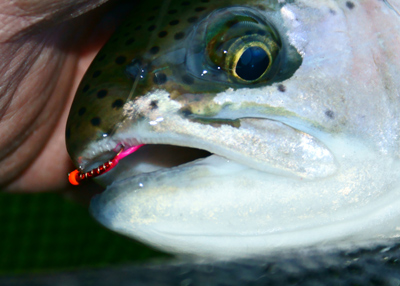
As three of us were in the boat we all positioned our flies at different depths to quickly eliminate non-productive water.   Dustin was into fish in short order.  A healthy plump Sheridan rainbow took his small black and red Ice Cream Cone roughly nine feet down.  After a spirited fight the rainbow soon lay in the net.

A quick throat pump confirmed I was on the right track.  Dustin’s rainbow was stuffed with #12-#10 bloodworm.  The 5/8th’s to ¾’s inch bloodworm were writhing like mad.  Just a few seconds ago they were moving just above the bottom or within the tube-like homes they construct along the bottom.  Trout have no issue vacuuming larvae right from the relative safety of the their homes and if the bloodworm are free and moving about their feeble head to tail swimming motion offers zero resistance to a foraging trout.

Regurgitated bloodworm
Based on this information we soon changed flies to represent bloodworm.  Jared and Dustin each tied on Vernille or Plush Chenille San Juan Worm and I swapped to a #10 Bionic Worm on the point and a straight shank Holo Worm on the point.   I wanted to see which shank profile trout preferred.  If trout favor wriggling bloodworm then a curved shank pattern is the better choice.  Conversely, if trout are taking the bloodworm as they rest after wriggling about, which they tend to do in an extended position, then a straight shank pattern is the wiser option.  If I am fishing a long leader without an indicator I often start with straight shank patterns as with this method the flies are pulled through the water more than when using indicators.  Some days it doesn’t matter and either philosophy works.

Jerry McBride's Bionic Worm
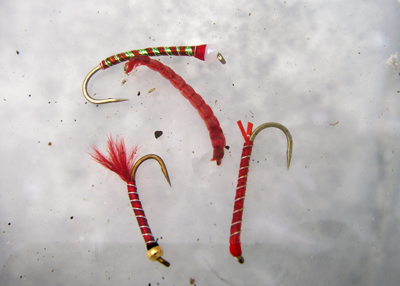
Bloodworm patterns don’t inspire angler confidence.  To some they are nothing more than a slender red or maroon stick.  Successful patterns need to be slender, just like the naturals.  If you want some tips on bloodworm patterns please check out Bloodworm Basics in the Fly Patterns section of my website.

Bloodworm patterns need to be slender to match the naturals
As bloodworm are found on or just above the bottom I left my point fly hanging about one foot off the bottom and wasn’t having much success.  Dustin had three or four takes in a row with his flies at nine feet.  That was enough information for me and I slid my indicator down towards my flies and hung my Bionic Worm at nine feet.  This tactical change was the ticket and we had a great couple of hours.  Rainbows show a particular affinity for Jerry McBride’s Bionic Worm.  Make sure you have more than a few rows in your fly box ready to go.

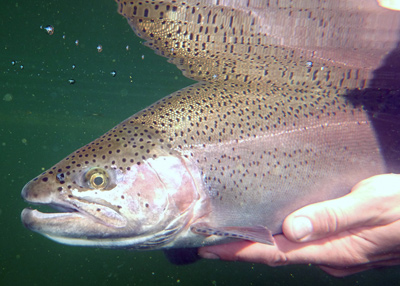
Sheridan rainbow loved Bionic Worms
This approach continued throughout the day with each pair of students that joined me in my boat.  I went back to the same spot each time and took fish.  To quote an old guide’s adage, “Don’t leave fish to find fish.”   One large fish we caught regurgitated over 20 bloodworm in the landing net.  They were definitely the priority food that day on Sheridan.

Sam, with one of Sheridan's trophy rainbows taken on using a chironomid larva (bloodworm) pattern
The next time you aren’t sure what pattern to tie on consider something that imitates a staple prey item and bloodworm in particular. Chances are you won’t be disappointed with the results.

Thursday, July 5, 2012

Dangling in the Parklands

In early June I once again visited the lakes in the Parklands region of S.W. Manitoba. As with previous excursions I was  providing back to back hosted stillwater seminar trips for 26 fly fishers, all keen on improving their stillwater fly fishing skills.   I have been providing these hosted stillwater seminar trips for over four years now.  I venture out each spring and fall.  For some of my students these trips are starting to form part of their annual fly fishing adventures.  Seeing old friends on each trip is a welcome bonus.

Pauline shows why she keeps coming back to the  Parklands.  This local resident was  27" long and had a 17" girth.  That's over 10lbs! (Photo Courtesy of Barry Stokes)

Some of my students have visited these waters on their own but after seeing the success and camaraderie within in our groups chose to participate in my hands on seminar format to grow and develop their stillwater skills.  Fifteen or more anglers all working together provides an excellent learning environment and during our debrief sessions expedites figuring out just what the fish want.  The synergy is similar to a group working efficiently on a large jigsaw puzzle as opposed to one or two people struggling to get it completed.

Bob Vanderwater (left) and I present Bob Morenski (center) with a cheque for $500 
(Photo Courtesy of Bob Vanderwater)

The lakes we target on these trips are public waters chosen for their potential to produce quality rainbows, browns and aggressive tiger trout.  Getting to these lakes just takes time, for me about 10 hours.  The lakes offer easy access and great launch areas, even some camping.  But these lakes didn’t happened by accident.  The Fish and Lake Improvement Program for the Parkland Region (FLIPPR) works with local rural municipalities to make the incredible stillwater fishing the Parklands is becoming famous for a reality.  But like all groups they need our help. For example, the electrical cost to run aerators on the lakes isn’t cheap.  Without winter aeration most of these quality lakes would perish due to winter kill.  Our students, most awestruck with the fishing they were experiencing, were keen to support FLIPPR so they could return in the future.  Bob and Karen Vanderwater, who provide invaluable help in administering and coordinating my trips, and I agreed.  Everyone in both groups donated funds and on behalf of both groups Bob, Karen and I were pleased to present FLIPPR board member Bob Morenski with a cheque for $500 towards their ongoing efforts to maintain these lakes.  If you visit the Parklands region we encourage you to do the same.  It is a small price to pay.

Chironomids were on the menu

As with my spring 2011 trip chironomids were front and center, providing me with the opportunity to introduce students to my absolute favorite way to fly fish lakes.  One group, who were joining me for a second straight year from the Ottawa area, came specifically to learn how to fish chironomids.  Thankfully Mother Nature was in an excellent frame of mind and this trip would allow me to provide instruction using three different chironomid presentation techniques, the naked technique, indicators and full sinking lines or ‘dangling’.  It is rare to be able to provide comprehensive instruction on all three methods as often conditions and trout location dictates only one or two methods, typically those involving floating lines.

I have touched on strike indicator tactics and most recently in my previous blog entry entitled, “Naked in Utah” the naked technique previously.  Dangling is another deadly but not widely used or known technique. 

Big fish like chironomids and lots of them!

Dangling involves a full sinking line from an anchored position.  I prefer type V or VI density compensated lines such as Rio’s Deep series of lines.  You can dangle with slower sinking lines too.  Some of my students did well using clear intermediates. Typically, dangling  works best in water too deep for floating lines, 20 feet or greater but it can work in water as shallow as 12 feet if conditions are right such as windy conditions or water with reduced visibility due to suspended algae.
Leaders are short, 3-6 feet depending upon the number of flies you are using.  The more flies the longer the leader.  I often use a short length of 2x or 3x tippet attached to the fly line loop using a loop to loop or improved clinch knot.

Tiger's love deep water during the day.  They are a perfect candidate for dangling.

The key to dangling is to accurately set the depth so your flies suspend roughly one foot off the bottom.  To do this we used a technique often used to set indicator depth.  Attach a pair of hemostats to the fly and lower it over the side.  Strip off enough line to allow the hemostats to sink to the bottom until the line goes slack.  Reel the line in until you just feel the weight of the hemostats.  Reel in two to three more times ensuring the flies sits just off the bottom.  Strip in the line and remove the hemostats.  You can mark the line with a small section of masking tape so you can find your mark again after you land a fish.  Rio’s new lines feature a built in hang marker set at 13 feet.  I make note of which guide the marker is near and use this to reset my line.

You know you are just above the bottom when you hook a sucker.  Part of my Tokaryk Gand Slam.

With the line distance figured out make a cast.  It looks like you threw the line over the side of the boat, 18-20 feet of line and leader isn’t much.  Avoid the temptation to strip off more line.  If you do all you end up doing is dragging your flies through the mud and debris along the bottom. Let the line sink so it is hanging or dangling directly below the rod tip.  Yes you are fishing directly below your boat, pontoon boat or float tube.  You can let the flies sit below or after a while begin a slow handtwist retrieve with lots of prolonged pauses and bring the flies up through the water column.

Be warned most takes are not subtle.  Hang onto your rod if you aren’t careful it is possible to have the rod ripped from your grip.  A rod with a soft forgiving tip is not a bad idea.  Trout tend to come over the top of the fly and if you are bringing the fly up and the trout is going down the resulting strike is hard and aggressive.  Don’t be fooled by takes as the end of the fly line nears the surface.  Trout often follow the fly up through the water column taking only a few feet below the surface.  Who says fish are afraid of boats?

My standard dangling pose

I encourage you to give dangling a try.  It is a great method to use on windy days and it offers a social element as well as you can carry on a conversation without having to have an eye or both eyes on a floating line or strike indicator.  Short of being unconscious you won’t miss a strike. 

There is still space available for my fall hosted schools, September 13-17, 2012 and September 17-23, 2012.  Please click here for more information.

Thursday, July 14, 2011

Fishing Local Water


Yesterday I managed to sneak out and fish a local lake with friend Brian Wiebe. With my travels so far this is only the second time I have been able to venture out locally. I was glad Brian motivated me to get onto the water.

Weather was overcast with a slight breeze from the north east. We were just experiencing the last of a low pressure system that has been bombarding us with rain and wind for the past few days. Thankfully the sunny weather is returning as I type.

I chose to fish out of my Outcast Pac 9000 as the launch was a bit dicey for my 14 foot jon boat. The PAC 9000 is a beautiful platform to fish from, very spacious and comfortable.

My Pac 9000 loaded and ready to go

We rowed down to the far end. As I got my exercise in for the day I asked myself, “Why is the fishing always the best at the far end of the lake?” About 10 minutes or so later I was in position ready to go, double anchored in 10 feet of water. 

During my paddle I noticed lots of small chironomid shucks on the water along with a few #14 Callibaetis duns. Taking my observations into account I began with #14 black and red Ice Cream Cone coupled with at #14 Gold Bead Pheasant Tail (GBPT) Flashback dropper roughly 24 inches above. 

Quick Release Indicator about to dissappear

I made my first cast settled into my seat and within seconds my Quick Release Indicator disappeared. One of the lakes smaller residents, barely 12 inches long had inhaled the Ice Cream Cone. Not a bad start I thought. From that point on the action was steady. The fish were small but scrappy and lots of fun on my 4 weight. A few fish later I managed to get one over 14 inches that I was able to obtain a throat sample. They were feeding heavily on #16 and smaller olive chironomid larva.  There were also half dozen #14 dark olive and black chironomid pupas contained within the sample, some of them inflated and silver. Despite the reasonable numbers of Callibaetis duns drifting there were no nymphs or duns in my samples. Chironomids were on the menu.

Fish were active and willing to play!

After a few more fish I took off the indicator as I was changing my dropper fly to a small Chromie. I took a fish on my first cast using the ‘naked’ technique and continued to take fish on a steady basis. I switched back to the Quick Release Indicator so I had something to stare at while I ate lunch. I never moved until it was time to go! It was nice not having to chase fish all over the place!

Brian has success working the shoreline shallows

Brian did equally well and diligently worked the shallow reaches near the shoreline bull rush.  He locked horns with a few larger fish and managed to land on of the larger residents the lake is beginning to produce. His larger fish took his suspended leech pattern but as with my smaller fish it too was stuffed with chironomid larva and pupa. Brian’s leech must have looked like the perfect desert!

Brian is pleased with his results

I fished until just after 5pm, all in all a rewarding day. I made a promise to myself to try and get out more often over the coming months. I am fortunate to have a number of great little ‘pot hole’ lakes within an hour or so from home. Often we travel great distances to experience what is lying in our backyard.

Monday, October 25, 2010

California Trout and Pigskin

I recently returned from a week long speaking and seminar jaunt through Washington and California.  My journey started as Spokane’s Inland Empire Fly Fishing club welcomed me where I presented my Favorite Western Canada Stillwaters program.  This is the second time I have spoken to the Inland Empire club originators of the best selling book Flies of the Northwest.  Bob Harley and the rest of the club members provided an excellent dinner and in addition to my presentation I tied a few of my favorite flies for them as well.  The Inland Empire club is home to Jerry McBride, originator of the balanced fly concept that has changed the way I tie and present many of my patterns.  It was great to see him and thank him personally for his innovative approach to pattern design.
 
After my evening in Spokane I flew out early the next morning carrying on down to Santa Rosa California where I put on my Going Deep-Sinking Line Strategies for Stillwaters presentation to the Russian River Fly Fishers.  Prior to my presentation club member Joe Banovich took me out to a local smorgasbord restaurant for dinner.  What a spread! I gorged myself silly, totally blowing my diet.  I am a sucker for Sushi in particular and they had lots on hand! 

Lake Davis is a beautiful place to drown flies!
After my presentation was complete I immediately headed north to Clio California where I would be putting on a two day stillwater seminar with Bill Forward.  Bill is the Senior Editor with Sierra Fisherman magazine and owner of Forward Bound Guiding and Fly Fishing Instruction.  

Bills beautiful 16' boat, perfect for a day's fishing!
Over the Friday night and Saturday Bill and I provided two days of instruction to 19 enthusiastic students eager to improve their stillwater fly fishing skills.  Students were provided a number of seminars including how to read lakes, equipment requirements for stillwaters, stillwater entomology, presentation skills, and the intricacies of using indicators on lakes.  In addition to the lectures students were given a chance to get on the water and hone their skills.  At the end of the on the water segment of the seminar Bill and I provided a de-briefing as students discussed their successes, setbacks and observations.  This format provides great interaction and arguably provides the greatest learning opportunity.  Feedback has been extremely positive. This was our first seminar and based upon this positive feedback we are already working on plans for additional seminars for 2011.  Stay tuned to my blog, Facebook page and website for additional details once they are figured out.

Pug nosed Lake Davis rainbow
During my stay I had the opportunity to fish Lake Davis, one of northern California’s most well known stillwaters and one of my ‘bucket list’ lakes.  Fishing was steady and despite the slowly deteriorating weather both Bill and I did well.  Trout were cruising high in the water column and small chironomid pupa and flashback gold bead Pheasant Tail Nymphs suspended 3-5 feet down proved deadly.  On the last day in particular I did well presenting my flies within the foam of the wind lanes that began to form in the afternoon.  As with most days the fishing hit a crescendo just as it was time to pull anchors and wrap up our stillwater seminar.   

Hanging flies in and around weed pockets proved productive
Lake Davis is unique as it provides the opportunity to stalk fish from shore.  Fish were in the shoreline shallows, often in barely enough water to cover their backs, rummaging for food.  If your presentation was correct they took dry flies readily.  This phenomenon is rare.  Most lakes don’t allow much wading or stalking opportunities due to back cast issues, shoreline weed growth or soft muddy bottoms that make wading and stalking nasty or in some cases outright dangerous.

The line up to get in the parking lot 2.5 hours before game time!
After winding up the seminar Bill, his wife Carol and I headed south to San Francisco to attend the San Fransico 49rs vs. Oakland Raiders football game.  For those of your familiar with the bay area this game offers an intense rivalry.  This was my first NFL game and as a die hard Niners fan it was the icing on my trip.  We were on our way by 6:00am for the roughly four hour drive arriving at Candlestick Park just after 10:00 for the experience that is tailgating.   

Me in my 'colors'
Bill provided me with a Niners golf shirt and jacket to ensure I had my colors straight.  He toured me around the parking lot as I took in the entire experience, from an inflatable Darth Vader to a big screen TV complete with satellite to watch the early games.   

The tailgating experience

Raider Nation was well represented.
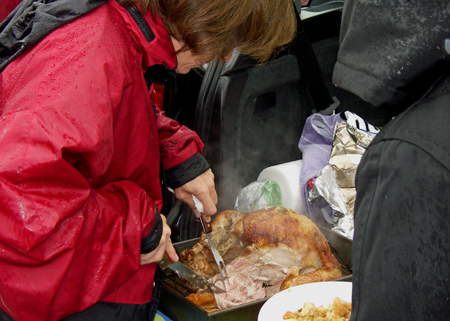
All manner of food was cooked and consumed in the parking lot along with sufficient quality of suitable beverages.  Our tailgate group dinned on a full turkey dinner complete with brussel sprouts (which I actually like), stuffing and potatoes.  A few glasses of red wine washed the meal down perfectly.  

Nothing beats a full course turkey dinner before a football game!
The game itself was great as the Niners finally won their first game of the season 17-9.  It rained through most of the tailgate party and first half so the ponchos we picked up on our drive proved wise to say the least.

We finally won!
I flew home the next morning after a tour of Bill’s home town San Francisco and a wonderful dinner on world famous Fisherman’s Wharf.  It was a whirlwind trip but well worth the investment.  I can’t wait to return in 2011!

Sunday, October 10, 2010

Fall Paradox

For me the fall season is a paradox.  Mother Nature takes out her paint brush decorating trees with beautiful yellows, oranges and reds all contrasted against magnificent deep blue skies.  At the same time fish sensing the onslaught of winter cruise the shallows consuming just about everything they come across.  The days are numbered.  In north central Alberta any warm days we get after Halloween are a blessing.  Trout and some of the largest pike of the season are on my radar.  I will be trying to get all fishing I can in before it becomes cold, white and hard again. As Charles Dickens once wrote, “It was the best of times, it was the worst of times.”

Fall colors are spectacular
In late September I wrapped up my final shoot for The New Fly Fisher on the North Saskatchewan River near my home in the Edmonton area chasing pike, walleye and goldeye with Keith Rae from Get Hooked Adventures.  The weather was spectacular as the fall colors were just beginning to manipulate the landscape.

A definite no fingers zone!
Navigating the river via Keith’s comfortable jet boat we tossed streamers on sinking lines along the current edges for walleye and goldeye and in the slower reaches floating lines and large flies pulled some large 35-inch and longer pike.  The savage grab of a pike on the fly is addictive and I recommend everyone give it a try.

Keith Rae and I enjoying fly fishing for Pike on the North Saskatchewan
At the same time water boatman and backswimmers begin their annual mating and migration flights.  These insects become active in the mid to late afternoon when the sun’s rays warm the shallows and get them going.  I spent a day on a local lake.  Fishing began slow and sporadic at best.  Random acts of kindness if you will.  About four o’clock we began to see the first aggressive swirls of the day.  Fish were working in and along the deep edge of the weed beds targeting backswimmers as they left the water and when they returned.  Casting foam bodied Ultimate Boatman on hover and floating lines was spectacular.


A fat fall rainbow taken on an Ultimate Boatman

Throat pump analysis revealed backwimmers were on the menu
Takes often came as the fly landed, its arrival.  I recall one large trout that took my fly in a graceful but aggressive porpoise rise.  If the fly isn’t taken upon landing or on the drop a brisk hand twist or 4-5 strip retrieve typically garners a strong response.  Large trout hooked in water less than five feet deep often go berserk.  When the ‘fall’ is in full swing boatman and back swimmer patterns offer some of the most memorable fishing of the season.

I had the chance to check out Stoney Lake before the students arrived
The first weekend in October saw me at Stoney Lake Lodge in British Columbia.  Good friend Brian Chan and I put on our first Learning with the Pros-Advanced session in partnership with B.C. Outdoors Sports Fishing magazine.  Fourteen ardent fly fishers joined Brian, Editor Mike Mitchell and I.  Some of the students came from as far away as Ontario and Wisconsin!  Both the weather and fish cooperated as students spent time on the water with Brian and I after each mornings seminars.  Boatman, , backswimmer, leech, dragon nymph patterns and Boobies all took their share of fish.  From the feedback we received everyone enjoyed their experience and the accommodation and food was fantastic.  Saturday nights prime rib dinner was one of the most memorable feasts I have ever experienced.

After the weekend school I stuck around for a couple of days and filmed two episodes for BC Outdoors Sports Fishing new television show.  This new show begins airing later on this fall on WFN and a number of B.C. networks. 

So if you can get out this fall and experience some fishing for yourself, it won’t be long before the winter is upon us.  Our memories will be the only things left to carry us through the cold months and at the fly tying station.