Showing posts with label Fly Fishing Stillwaters. Show all posts

Monday, November 12, 2012

Bloodworms-The Underrated Staple


This past October proved to be one of my busiest.  I spent time in Manitoba, Idaho and California providing seminars and hosted trips.  With each trip I was fortunate to spend time on the water chasing the last stillwater trout of my 2012 season.
 
Staples such as bloodworm are an excellent fall pattern choice

Fall is one of my favorite seasons when it comes to stillwater fly fishing.  As frost begins to predominate the daily fall forecasts, trout prowl the shallows continuing to build the fat reserves that will carry them through the long cold winter ahead.  At this time use pattern and presentation techniques to suggest staple food items such as leeches, forage fish, scuds, immature dragon and damsel fly nymphs and perhaps the most underrated stillwater staple, chironomid larva (bloodworm).
Sheridan sample

Bloodworm patterns are one of my favorite stillwater staples to imitate.  During the fall months this bread and butter prey item is often on the menu.  When I was down in Idaho I spent time on both Henry’s Lake and Sheridan Lake.  Sheridan is a private fishery known for its large rainbow trout.  I had the pleasure of fishing Sheridan last year and I was looking forward to fishing it once again.
 
The weather was perfect, bright clear skies and crisp just below zero temperatures to start the day, my favorite combination for fall fishing.  Water levels were low and fish were rolling on the surface.  It seemed to take forever to get my gear ready and my Yamaha G3 1756 VBW into the water.  I loaded my first two students, Dustin and Jared into the boat.  Off we went in search of trophy trout.

Large trout love chironomid larvae
Thankfully we didn’t have to go far.  The water was clear as the frigid overnight temperatures caused the algae to clump and sink.  Fish were moving at the opening to a large shallow bay that sloped gently into deeper water.  As there was no definite structural transition such as drop off I chose to take advantage of another form of transition, light to dark.  Trout love to prowl in the cover of shadow or shade.  In low light conditions they hunt confidently and aren’t as spooky as if they were in shallow clear water.  With this approach in mind we anchored the bow of the boat just where it was difficult to make out the bottom.  We anchored the stern in dark, deep water.  This placed us in roughly 10-12 feet of water. 
Floating lines and indicators were the order of the day.  Experience taught me that a leech or bloodworm pattern on the bottom with a chironomid pupa on a dropper would be a good place to start. 

As three of us were in the boat we all positioned our flies at different depths to quickly eliminate non-productive water.   Dustin was into fish in short order.  A healthy plump Sheridan rainbow took his small black and red Ice Cream Cone roughly nine feet down.  After a spirited fight the rainbow soon lay in the net.

A quick throat pump confirmed I was on the right track.  Dustin’s rainbow was stuffed with #12-#10 bloodworm.  The 5/8th’s to ¾’s inch bloodworm were writhing like mad.  Just a few seconds ago they were moving just above the bottom or within the tube-like homes they construct along the bottom.  Trout have no issue vacuuming larvae right from the relative safety of the their homes and if the bloodworm are free and moving about their feeble head to tail swimming motion offers zero resistance to a foraging trout.

Regurgitated bloodworm
Based on this information we soon changed flies to represent bloodworm.  Jared and Dustin each tied on Vernille or Plush Chenille San Juan Worm and I swapped to a #10 Bionic Worm on the point and a straight shank Holo Worm on the point.   I wanted to see which shank profile trout preferred.  If trout favor wriggling bloodworm then a curved shank pattern is the better choice.  Conversely, if trout are taking the bloodworm as they rest after wriggling about, which they tend to do in an extended position, then a straight shank pattern is the wiser option.  If I am fishing a long leader without an indicator I often start with straight shank patterns as with this method the flies are pulled through the water more than when using indicators.  Some days it doesn’t matter and either philosophy works.

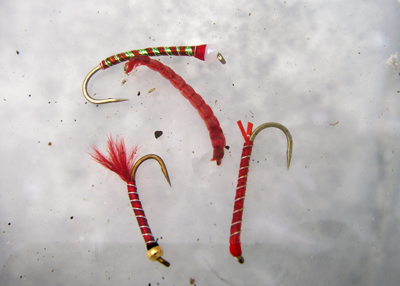
Jerry McBride's Bionic Worm
Bloodworm patterns don’t inspire angler confidence.  To some they are nothing more than a slender red or maroon stick.  Successful patterns need to be slender, just like the naturals.  If you want some tips on bloodworm patterns please check out Bloodworm Basics in the Fly Patterns section of my website.

Bloodworm patterns need to be slender to match the naturals
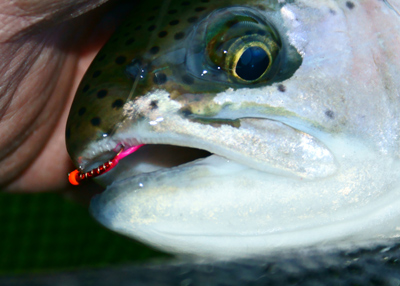
As bloodworm are found on or just above the bottom I left my point fly hanging about one foot off the bottom and wasn’t having much success.  Dustin had three or four takes in a row with his flies at nine feet.  That was enough information for me and I slid my indicator down towards my flies and hung my Bionic Worm at nine feet.  This tactical change was the ticket and we had a great couple of hours.  Rainbows show a particular affinity for Jerry McBride’s Bionic Worm.  Make sure you have more than a few rows in your fly box ready to go.

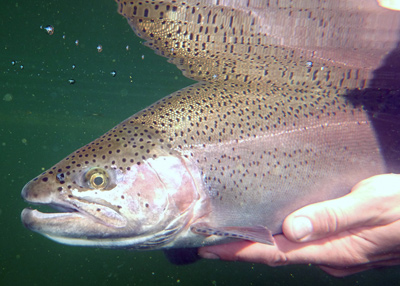
Sheridan rainbow loved Bionic Worms
This approach continued throughout the day with each pair of students that joined me in my boat.  I went back to the same spot each time and took fish.  To quote an old guide’s adage, “Don’t leave fish to find fish.”   One large fish we caught regurgitated over 20 bloodworm in the landing net.  They were definitely the priority food that day on Sheridan.

Sam, with one of Sheridan's trophy rainbows taken on using a chironomid larva (bloodworm) pattern
The next time you aren’t sure what pattern to tie on consider something that imitates a staple prey item and bloodworm in particular. Chances are you won’t be disappointed with the results.

Wednesday, May 23, 2012

On-Line Stillwater Fly Shop is Now Open

For a number of years now people have always been asking good friend Brian Chan and I about where they can find stillwater specific products.  Well, Brian and I are pleased to announce that our new online Stillwater Fly Shop is now open.

Brian and I invite you to visit Our On Line Stillwater Store for Your Stillwater Fly Fishing Needs

Presently, you can find all of our books, DVD's, Quick Release Indicators, jig hooks for balanced flies along with a complete selection of our favorite Stillwater Solutions patterns.

We will also be adding new products on a regular basis so please check back often.  If you have a specific stillwater product need please let us know.  Chances are others will be interested in it too and we can perhaps add it to our store.

Your feedback is always welcome and appreciated so please enjoy.  You can access the store directly through the 'on-line' store link located along the left margin of my website or proceed directly to the store website.

A direct link to the store will soon be available through Brian's website too.

Wednesday, May 25, 2011

On the Water at Last!

As most of you probably know, this past winter was one of most severe on record.  Only recently have the lakes in my area become ice free.   I have managed to keep myself occupied with a number of speaking engagements, seminars and schools.  Getting on the water has been tough both physically due to the snow and ice and mentally as the excitement that precedes a new season could not be satiated!

This past week I flew to B.C. for three days of fishing with my friend and colleague Brian Chan.  Brian and I don’t get to spend as much time as we would like together on the water so trips like this are a treat and we get to discuss future projects, seminars etc.

Six Mile Lake

Each day we visited a different lake.  Day one started at Six Mile Lake.  The weather was great, sunny and warm and a light breeze.  The trout were reasonably cooperative and the day began using small #16 olive or lime green chironomid pupa patterns such as my Pearl Pupa from my first book, Fly Patterns for Stillwaters.  Trout were shallow and we did best in the shallow water less than 10 feet.  Callibaetis duns also appeared in our throat pump samples and in the early afternoon they began hatching in earnest.  Anchored close to shore we watched the duns drift out over the deeper water on the shoal only to be consumed one at a time in splashy aggressive swirls.  Brian took a number on a parachute Adams and I took fish on a bead head version of my Turkey Quill Callibaetis, all in all a great start to the trip.

Callibaetis began emerging in decent numbers during the afternoon on Six Mile

Day two saw a weather change.  Temperatures dropped, the skies were gray, full of moisture laden clouds.  Deciding to stay close to Kamloops in case we had to beat a hasty retreat we launched the boat at Jacko Lake.  Chironomid pupa, black and red to be specific and balanced leeches were the order of the day.  Chironomids were hatching in reasonable numbers and swallows were working the shallows hard dipping and diving to pick off as many of the emerging adults as they could.  Swallows are an excellent hatch indicator to pay attention too.  Fish were not in a terribly cooperative mood due to the changing weather but we managed to do reasonably well in light of the conditions.  As with Six Mile the day before, fish were in the shallows.  By days end were both satisfied and saturated.  The warm shower at the end of the day provided a welcome respite.

Brian releases a small rainbow

Day three started with worse weather than day two.  We were greeted by steady rain and as we headed higher in elevation to Heffley Lake near Sun Peaks Resort the steadily declining temperature gauge in Brian’s truck got us worried about the possibility of snow.  Thankfully were a few hundred feet lower than the visible snow line.  Steady rain stayed with us all morning testing our will, raingear and choice of layered clothing.  By noon we decided to head for shore where we cooked smokies over a small campfire.  Although challenging to get going the heat it provided made all the effort worthwhile.  After lunch the clouds began to lift and rain abated.  Fish were on the shoals and in the relatively clear waters Heffley is known for our quarry could often be spotted cruising the lighter marl patches.  Trout were not concentrated and we moved often to keep in touch with the cruising trout.  Areas adjacent to deep water proved to be our most consistent strategy.  As with Jacko the day before fishing was steady but not spectacular.  Trout were feeding on small chironomids and we did have some success using pupa patterns.  But by far our best results came from hanging small black micro leeches beneath indicators.  Brian and I chatted back and forth as to the reasons for this preference.  We weren’t using balanced patterns for the most part and perhaps the small slender profile of our micro leech patterns suggested staging chironomid pupa?  Most of the pupae that were emerging were olive, dark olive and black.

Keep an eye out for swallows working low over the water, a sure indication a hatch is taking place.

The Kamloops area lakes are starting to get into full swing.  Water temperatures at Six Mile, Jacko and Heffley were all within a few degrees of each other, between 54F and 56F.  Good temperatures, as 50F is the typical trigger point for the season’s first chironomid hatches to get going.

Now that the stillwater season is at my feet I intend to spend as much time on the water as I can, both locally and afar.  Stay tuned for reports from California, BC once again and in June the magnificent lakes of the Parklands region of southwest Manitoba.

Wednesday, September 8, 2010

Prowling the Parklands-Fall Report

This past Labor Day weekend found me once again prowling the productive stillwaters of the Parkland's region of southwest Manitoba.  As with the spring, I led a group of nine enthusiastic fly fishers, most of which had only heard about the stillwater riches this region has to offer. Bob and Karen Vanderwater worked with me once again helping coordinate this event.  Their help and support is invaluable and provides an element of polish to the whole trip.  

Twin Lake Tigers, just one of the Parkand's stillwater attractions

We based ourselves out of the Barn in the Bush located at the southern end of Lake of the Prairies.  Barn in the Bush, as its name would suggest, is a refurbished barn converted into squeaky clean comfortable living quarters.  All of the lakes we visited on this trip, Tokaryk, Patterson and Twin were roughly an hour away.  Owners Steve and Betty Morris provided wonderful accommodations and put up with our early morning convoys to the various lakes.  If you are looking for great accommodation complete with queen size beds, kitchenettes, individual washrooms and showers in each room then Barn in the Box is the place to be.  It was the perfect base for our group.

Barn in the Bush provides great accommodation

Day one began bright and early with a large bacon and egg breakfast.  Lunches were made and we were soon on our way to Tokaryk Lake near the town of Oakburn.  Those of us within our group who had fished Tokaryk in the spring were full of anticipation. Tokaryk had been spectacular in June, both in average fish size and quantity.  This time fishing was a bit tougher as the region was just recovering from a bout of unsettled weather.  We did not get into the numbers we had originally hoped for but the size and quality of the fight was as we remembered.  A variety of patterns produced fish for most of the group including leeches, dragon nymphs and flashback bead head Pheasant Tail nymphs.  Although it was early fall I took all of my fish on chironomid pupa patterns.  By the fall stillwater trout have typically seen so many chironomid pupa over the course of the season that they respond to a properly presented pattern in an almost Pavlovian fashion.

Tokaryk rainbows still like chironomids

The next day we visited Patterson Lake, a mere stone’s throw from Tokaryk.  Patterson is a large trophy lake containing browns and rainbows.  Typically this lake challenges the fly fisher but every time the line locks up or the indicator plunges beneath the surface chances are it is going to be a big fish.  Today was no exception.  The day was sunny and pleasant but the wind was blowing from the east, a precursor to changing weather.  I expected tough fishing.  One of the students, Mike joined me for the first two hours and was into fish almost immediately on a balanced leech.  This fish managed to wrap the line around both the bow anchor rope and electric motor.  However, with some creative ‘gymnastics’ and teamwork we were able to free the line and land a nice fish.   Two other students Rob and Gerald joined me later in the day catching some of the largest fish of their lives.

Gerald's first Patterson brown

Bob and Karen began at their usual spot near the beaver lodge on the southeast end of the island but soon moved through the narrows and into the bay on the island’s north side to get out of the persistent easterly wind.  Taking advantage of the wind lane that formed downwind of the ‘narrows’ they did well hanging flashback bead head Pheasant Tails beneath an indicator.  Soon the rest of the group gathered there and I experienced one of my best days on Patterson.  A flashback Pheasant Tail on the point and a small #14 boatman dropper produced consistently.  The waters were alive with immature fat head minnow fry and the flashback Pheasant Tail did a great job suggesting them.  Throat samples revealed minnow remnants and tiny water boatman.  As the day wore on a few browns trickled into the mix and both Karen and I managed to wrestle a few Patterson residents.

Patterson browns are big and fat

Two members of our group, Doug and Rick, supported by a desire to explore and a well charged battery explored the far end of Patterson and had a fantastic day.  Doug took the largest fish of the trip, a magnificent 28 inch rainbow.

Now that's a rainbow!

It was a great day, all of us were glowing from the bright sun and the numbers of fish we had caught and released, a true testimony to the quality of the Parkland's area lakes.

Twin Lakes tigers like foam boatman and back swimmer patterns

Our final day found us hunting for tiger trout on Twin Lakes located a short drive north of Roblin.  Twin is a catch and release fishery full of large aggressive tiger trout.  The day however started slowly.  A large low pressure system had swept up from Montana and blanketed Saskatchewan and south western Manitoba.  The normally cooperative tiger trout weren’t willing to play right away.  By midday most had yet to dance with a tiger.  I was fortunate to land one on an Ultimate Boatman cast tight to the shoreline tules.  In the early afternoon fortunes began to change.  Doug figured things out by casting tight to the tules with a variety of boatman patterns, managing to land over a dozen tigers.

Steve and Betty admire a Twin Lakes tiger

During the previous nights session I provided the group with an overview of Twin and made a point of mentioning a tiger trout’s willingness to come to the surface.  Doug soon switched from his boatman patterns to a large Chernobyl Ant and continued to take large tigers on the surface.
 
Twin Lakes tiger returns to its haunt

Foam based boatman and back swimmer patterns were the patterns of choice as their buoyant nature was perfect for the shallows when used in conjunction with a clear AquaLux line.  On many occasions I would make a cast and a tiger would roll aggressively where my fly landed.  From time to time I thought the tiger had rolled on a natural boatman and as I stripped to cast and cover the rise I soon found out that the rise was actually to my fly. The take had not had time to transmit down the fly line.  Casting into gaps and channels in the tules was the winning ticket as tigers cruised in water barely deep enough to cover their backs.  This is a common sight during the fall period as trout stocking up for the long winter ahead prowl the shallows eating just about anything they come across.

Mike enjoying his Parkland experience

Our Twin Lakes adventure was the perfect cap to another superb trip.  Everyone in the group was beaming from their experiences over the weekend.  We are already working on a larger scale trip in June of 2011.  The June trip will offer the choice of a four day trip straddled over a weekend and a longer Tuesday to Sunday excursion.  Amongst the trip curriculum I will once again be providing a series of stillwater lectures, daily de-briefs and focused one on one time with each student to ensure maximum learning and the most rewarding experience possible.  If this sounds like something you would like to experience please let me know.  I will be putting a course handout together shortly.  By preliminary interest we have already received these trips will sell-out in short order. 

For more information and images from our trip please drop by my Facebook page and read Bob and Karen’s report on the Central Alberta Fly Tyers Blog.


Friday, August 6, 2010

Prowling the Parklands. The Sequel!

In the spring of this year I provided a Blog entry regarding the 12 fly fishers from central Alberta who accompanied me to the Parklands region of Manitoba.  For those of you who perhaps aren't aware the productive lakes located in the southwest corner of the province near the towns of Russell and Roblin are producing arguably the finest stillwater fly fishing in North America.
  
Patterson Lake, home to trophy rainbow and brown trout
From the remoteness of the experience, the average size of the fish and species diversity lakes such as Patterson, Tokaryk, Twin, and Pybus are tough to beat.  The lakes in this region are home to trophy rainbows, browns and the ultra aggressive tiger trout.

Tiger Trout
The response to my spring trip was overwhelming with many of the group who accompanied me wishing to return in the fall.  So once again I am  leading a group of fly fishers back to the Parklands this fall from September 2-6. We will enjoy three full days of fishing the regions lakes based out of  the Barn in the Bush situated between the towns of Russell and Roblin.  The trophy lakes we will be targeting on a daily basis are less than 40 minutes away!

An average Parkland Rainbow!

In addition to spending quality time on three different venues I will be providing a series of seminars each day along with a daily debrief.  I will also be available to provide assistance at the lake as well.  Here is an idea of what we will be covering.
  • Understanding Stillwaters-The Fall Perspective
  • Indicator Tactics for Stillwaters 
  • Fall Food Sources including Boatman and Back Swimmers Scuds and Leeches Instruction regarding retrieves and gear set-up
    Fall offers the chance to catch a true trophy
The cost for this fun and educational long weekend is only $575.00 CDN.  This fee includes accommodation, food and all seminars.  Your only additional cost would be alcohol and your transportation to and from the Parklands region of Manitoba.


Space is limited to 12 and only five spaces remain!

If you need any further information please don't hesitate to contact me either at flycraft@shaw.ca. It promises to be comprehensive, fun and informative weekend.  I hope to see some of you there.