Showing posts with label Forward Bound Fly Fishing. Show all posts

Friday, July 13, 2012

Adapting to the Conditions

As I try to report in each of my blog entries, each trip, seminar or school I provide always produces a lesson of its own.  My recent trip to California was no exception.

For the past three years I have travelled down to Lake Davis for the California Stillwater School I host with Bill Forward Senior Editor of Sierra Fisherman Magazine and local guide.  This past weekend 25 fly fishers joined us. Keen to improve their stillwater fly fishing skills.  Bill and I provide a series of morning and evening seminars over the course of three days.  During the day students put theory into practice as they fish Lake Davis.

Hovering Chironomids Greeted Us at the Boat Ramp

North America has been experiencing high temperatures and they would exact a toll on Lake Davis.  Skies were bright and clear and surface temperatures we up, touching 70F by midday.   These conditions would have a definite impact on fishing and we would have to adapt to be successful.   In years past working the shallows with damsel and Callibaetis nymphs was the way to go.  Early in the day this tactic worked as trout cruised the shallows picking off damsel and Callibaetis nymphs.  Callibaetis spinners were also present.  As we worked the shallow reaches along the west side of the lake delicate lazy rise forms of trout slurping spent spinners greeted each morning. 

I found the rises sporadic and inconsistent and decided that covering the water with a team of flies might be a wiser choice.  Using my Indicator line I rigged up a long 15’ plus leader with a Pheasant Tail Nymph on point, a Herl May on the middle dropper and a Stillwater Cruncher on the top dropper or bob position.  This combination proved effective coupled with a slow handtwist retrieve and 20 second countdown for the 8’-10’ water we were working.  But as the sun and water  temperature rose conditions changed.

Bill demonstrates the correct retrieve posture for the Naked technique

Trout vacated the shallows in search of cooler oxygenated water and to avoid the lethal attention of the local osprey’s and white pelicans.  A few fish remained in the shallows but they were spooky and few and far between.   Conditions dictated going deep.  I was also sensitive to targeting trout in warm water.  As water temperature increases its ability to hold oxygen decreases.  Exhausted trout would have a tough time recovering.  Ethics dictated targeting fish in cooler deeper reaches.

Lake Davis resident with a Collaborator top dead center

As Bill and I moved from one group of students to another checking on their progress we came across a strong chironomid emergence in deep water ranging from 16-18 feet.  Large chironomids, blood midge to the locals, were hatching in healthy quantities.  I was like a kid on Christmas morning as the pupa, shucks and adults of these dipteran presents littered the surface.  After checking on all of our students Bill and I headed back to deep water.  During our conversations with the students we encouraged them to join us.  Many did.

One of our students, John, with a healthy Lake Davis rainbow

Once we were anchored in position I grabbed my Deep Six line and tried ‘dangling’.  After a few casts my gut told me that trout were not concentrated in large numbers and that switching back to a ‘naked’ presentation using my Indicator line and long leader to cover water would be a better presentation choice. I love fishing floating lines and long leaders in water between 14-18 feet.
I swapped my flies, a #10 Summer & Red on point, a #12 Collaborator on the middle droper and swapped the #14 Herl May to the bob. After letting my flies sink for 30 seconds I began the painstaking slow handtwist retrieve common to this method.  About half way through my first cast I felt a short sharp pluck.  A feisty Lake Davis rainbow had latched onto my point fly.  The Summer & Red locked into its upper jaw. The trademark take for this method.  Bill also used a #12 Red Back Pheasant on his setup with equal effect.

Summer & Red

This scenario is common to many lakes as we head into the warm summer months.  Warm temperatures drive trout deep.  If they venture onto the warm shallow shoals it is usually late in the evening through until mid-morning when then head deep once again.  Weedy shoals are often preferred as during the daylight hours plants inject oxygen into the water as part of the photosynthesis process.  Getting on the water as early as possible and waiting until dusk are often the only consistent approaches to shallow water success.  During the heat of the day target water deeper than 15 feet.  A thermometer on a string is a valuable tool enabling you to probe the depths and find a temperature range more to the trout’s liking.

A thermometer on a string helps you probe the temperature at depth

Algae is also a common summer element.  Lake Davis was beginning to bloom.  Most fly fishers don’t see algae as an asset.  But in moderation it is.  Algae provides cover, absorbing the sun’s energy and keeping the deeper reaches cooler.  Algae is sunlight dependent and typically extends 6-10 feet down depending on the concentrations.
 
In shallow productive eutrophic lakes an algae die off in conjunction with high water temperatures strips oxygen and can result in a summer kill.  Trout are the largest oxygen consumers and in oxygen poor conditions pay the ultimate price.

Summer & Red and Red Back Pheasant pupa patterns proved successful

If this warm trend continues it is time to consider leaving trout alone until water temperatures drop.   It isn’t fair to add stress to their lives in these conditions.  Consider targeting other, more temperature tolerant species.  Run off should be subsiding, venturing out to your local rivers and streams is another enjoyable option.

When using the Naked Technique retrieves must be slow.

If you are based in the California area and are interested in attending one of our California Stillwater Schools please let me know.  Space is still available for our October 19-21, 2012 school.

Monday, October 25, 2010

California Trout and Pigskin

I recently returned from a week long speaking and seminar jaunt through Washington and California.  My journey started as Spokane’s Inland Empire Fly Fishing club welcomed me where I presented my Favorite Western Canada Stillwaters program.  This is the second time I have spoken to the Inland Empire club originators of the best selling book Flies of the Northwest.  Bob Harley and the rest of the club members provided an excellent dinner and in addition to my presentation I tied a few of my favorite flies for them as well.  The Inland Empire club is home to Jerry McBride, originator of the balanced fly concept that has changed the way I tie and present many of my patterns.  It was great to see him and thank him personally for his innovative approach to pattern design.
 
After my evening in Spokane I flew out early the next morning carrying on down to Santa Rosa California where I put on my Going Deep-Sinking Line Strategies for Stillwaters presentation to the Russian River Fly Fishers.  Prior to my presentation club member Joe Banovich took me out to a local smorgasbord restaurant for dinner.  What a spread! I gorged myself silly, totally blowing my diet.  I am a sucker for Sushi in particular and they had lots on hand! 

Lake Davis is a beautiful place to drown flies!
After my presentation was complete I immediately headed north to Clio California where I would be putting on a two day stillwater seminar with Bill Forward.  Bill is the Senior Editor with Sierra Fisherman magazine and owner of Forward Bound Guiding and Fly Fishing Instruction.  

Bills beautiful 16' boat, perfect for a day's fishing!
Over the Friday night and Saturday Bill and I provided two days of instruction to 19 enthusiastic students eager to improve their stillwater fly fishing skills.  Students were provided a number of seminars including how to read lakes, equipment requirements for stillwaters, stillwater entomology, presentation skills, and the intricacies of using indicators on lakes.  In addition to the lectures students were given a chance to get on the water and hone their skills.  At the end of the on the water segment of the seminar Bill and I provided a de-briefing as students discussed their successes, setbacks and observations.  This format provides great interaction and arguably provides the greatest learning opportunity.  Feedback has been extremely positive. This was our first seminar and based upon this positive feedback we are already working on plans for additional seminars for 2011.  Stay tuned to my blog, Facebook page and website for additional details once they are figured out.

Pug nosed Lake Davis rainbow
During my stay I had the opportunity to fish Lake Davis, one of northern California’s most well known stillwaters and one of my ‘bucket list’ lakes.  Fishing was steady and despite the slowly deteriorating weather both Bill and I did well.  Trout were cruising high in the water column and small chironomid pupa and flashback gold bead Pheasant Tail Nymphs suspended 3-5 feet down proved deadly.  On the last day in particular I did well presenting my flies within the foam of the wind lanes that began to form in the afternoon.  As with most days the fishing hit a crescendo just as it was time to pull anchors and wrap up our stillwater seminar.   

Hanging flies in and around weed pockets proved productive
Lake Davis is unique as it provides the opportunity to stalk fish from shore.  Fish were in the shoreline shallows, often in barely enough water to cover their backs, rummaging for food.  If your presentation was correct they took dry flies readily.  This phenomenon is rare.  Most lakes don’t allow much wading or stalking opportunities due to back cast issues, shoreline weed growth or soft muddy bottoms that make wading and stalking nasty or in some cases outright dangerous.

The line up to get in the parking lot 2.5 hours before game time!
After winding up the seminar Bill, his wife Carol and I headed south to San Francisco to attend the San Fransico 49rs vs. Oakland Raiders football game.  For those of your familiar with the bay area this game offers an intense rivalry.  This was my first NFL game and as a die hard Niners fan it was the icing on my trip.  We were on our way by 6:00am for the roughly four hour drive arriving at Candlestick Park just after 10:00 for the experience that is tailgating.   

Me in my 'colors'
Bill provided me with a Niners golf shirt and jacket to ensure I had my colors straight.  He toured me around the parking lot as I took in the entire experience, from an inflatable Darth Vader to a big screen TV complete with satellite to watch the early games.   

The tailgating experience

Raider Nation was well represented.
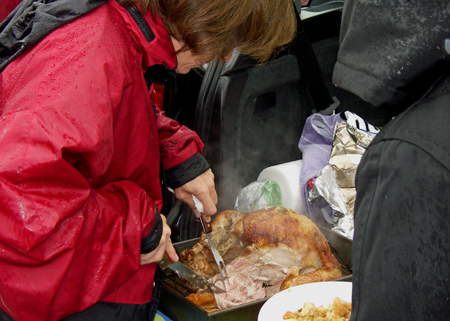
All manner of food was cooked and consumed in the parking lot along with sufficient quality of suitable beverages.  Our tailgate group dinned on a full turkey dinner complete with brussel sprouts (which I actually like), stuffing and potatoes.  A few glasses of red wine washed the meal down perfectly.  

Nothing beats a full course turkey dinner before a football game!
The game itself was great as the Niners finally won their first game of the season 17-9.  It rained through most of the tailgate party and first half so the ponchos we picked up on our drive proved wise to say the least.

We finally won!
I flew home the next morning after a tour of Bill’s home town San Francisco and a wonderful dinner on world famous Fisherman’s Wharf.  It was a whirlwind trip but well worth the investment.  I can’t wait to return in 2011!