Thursday, July 5, 2012

Dangling in the Parklands

In early June I once again visited the lakes in the Parklands region of S.W. Manitoba. As with previous excursions I was  providing back to back hosted stillwater seminar trips for 26 fly fishers, all keen on improving their stillwater fly fishing skills.   I have been providing these hosted stillwater seminar trips for over four years now.  I venture out each spring and fall.  For some of my students these trips are starting to form part of their annual fly fishing adventures.  Seeing old friends on each trip is a welcome bonus.

Pauline shows why she keeps coming back to the  Parklands.  This local resident was  27" long and had a 17" girth.  That's over 10lbs! (Photo Courtesy of Barry Stokes)

Some of my students have visited these waters on their own but after seeing the success and camaraderie within in our groups chose to participate in my hands on seminar format to grow and develop their stillwater skills.  Fifteen or more anglers all working together provides an excellent learning environment and during our debrief sessions expedites figuring out just what the fish want.  The synergy is similar to a group working efficiently on a large jigsaw puzzle as opposed to one or two people struggling to get it completed.

Bob Vanderwater (left) and I present Bob Morenski (center) with a cheque for $500 
(Photo Courtesy of Bob Vanderwater)

The lakes we target on these trips are public waters chosen for their potential to produce quality rainbows, browns and aggressive tiger trout.  Getting to these lakes just takes time, for me about 10 hours.  The lakes offer easy access and great launch areas, even some camping.  But these lakes didn’t happened by accident.  The Fish and Lake Improvement Program for the Parkland Region (FLIPPR) works with local rural municipalities to make the incredible stillwater fishing the Parklands is becoming famous for a reality.  But like all groups they need our help. For example, the electrical cost to run aerators on the lakes isn’t cheap.  Without winter aeration most of these quality lakes would perish due to winter kill.  Our students, most awestruck with the fishing they were experiencing, were keen to support FLIPPR so they could return in the future.  Bob and Karen Vanderwater, who provide invaluable help in administering and coordinating my trips, and I agreed.  Everyone in both groups donated funds and on behalf of both groups Bob, Karen and I were pleased to present FLIPPR board member Bob Morenski with a cheque for $500 towards their ongoing efforts to maintain these lakes.  If you visit the Parklands region we encourage you to do the same.  It is a small price to pay.

Chironomids were on the menu

As with my spring 2011 trip chironomids were front and center, providing me with the opportunity to introduce students to my absolute favorite way to fly fish lakes.  One group, who were joining me for a second straight year from the Ottawa area, came specifically to learn how to fish chironomids.  Thankfully Mother Nature was in an excellent frame of mind and this trip would allow me to provide instruction using three different chironomid presentation techniques, the naked technique, indicators and full sinking lines or ‘dangling’.  It is rare to be able to provide comprehensive instruction on all three methods as often conditions and trout location dictates only one or two methods, typically those involving floating lines.

I have touched on strike indicator tactics and most recently in my previous blog entry entitled, “Naked in Utah” the naked technique previously.  Dangling is another deadly but not widely used or known technique. 

Big fish like chironomids and lots of them!

Dangling involves a full sinking line from an anchored position.  I prefer type V or VI density compensated lines such as Rio’s Deep series of lines.  You can dangle with slower sinking lines too.  Some of my students did well using clear intermediates. Typically, dangling  works best in water too deep for floating lines, 20 feet or greater but it can work in water as shallow as 12 feet if conditions are right such as windy conditions or water with reduced visibility due to suspended algae.
Leaders are short, 3-6 feet depending upon the number of flies you are using.  The more flies the longer the leader.  I often use a short length of 2x or 3x tippet attached to the fly line loop using a loop to loop or improved clinch knot.

Tiger's love deep water during the day.  They are a perfect candidate for dangling.

The key to dangling is to accurately set the depth so your flies suspend roughly one foot off the bottom.  To do this we used a technique often used to set indicator depth.  Attach a pair of hemostats to the fly and lower it over the side.  Strip off enough line to allow the hemostats to sink to the bottom until the line goes slack.  Reel the line in until you just feel the weight of the hemostats.  Reel in two to three more times ensuring the flies sits just off the bottom.  Strip in the line and remove the hemostats.  You can mark the line with a small section of masking tape so you can find your mark again after you land a fish.  Rio’s new lines feature a built in hang marker set at 13 feet.  I make note of which guide the marker is near and use this to reset my line.

You know you are just above the bottom when you hook a sucker.  Part of my Tokaryk Gand Slam.

With the line distance figured out make a cast.  It looks like you threw the line over the side of the boat, 18-20 feet of line and leader isn’t much.  Avoid the temptation to strip off more line.  If you do all you end up doing is dragging your flies through the mud and debris along the bottom. Let the line sink so it is hanging or dangling directly below the rod tip.  Yes you are fishing directly below your boat, pontoon boat or float tube.  You can let the flies sit below or after a while begin a slow handtwist retrieve with lots of prolonged pauses and bring the flies up through the water column.

Be warned most takes are not subtle.  Hang onto your rod if you aren’t careful it is possible to have the rod ripped from your grip.  A rod with a soft forgiving tip is not a bad idea.  Trout tend to come over the top of the fly and if you are bringing the fly up and the trout is going down the resulting strike is hard and aggressive.  Don’t be fooled by takes as the end of the fly line nears the surface.  Trout often follow the fly up through the water column taking only a few feet below the surface.  Who says fish are afraid of boats?

My standard dangling pose

I encourage you to give dangling a try.  It is a great method to use on windy days and it offers a social element as well as you can carry on a conversation without having to have an eye or both eyes on a floating line or strike indicator.  Short of being unconscious you won’t miss a strike. 

There is still space available for my fall hosted schools, September 13-17, 2012 and September 17-23, 2012.  Please click here for more information.

Wednesday, June 27, 2012

Naked In Utah

For me, blogs seem like feast or famine.  During the off season things seem far less hectic.  Although I am typically speaking at shows and clubs the pace doesn’t seem nearly as crazy as the open water season.  During the off season I am subsequently able to keep up with my goings on and lessons learned.  Now I am just updating you on events that happened just over a month ago.

Falcon's Ledge Greetings Cards Await Every Guest

On the weekend of May 18-20th I was once again in Utah at Falcon’s Ledge for another of my stillwater schools.  The weather was fantastic, a far cry from the typically unsettled spring of western Canada. Due to flight delays I arrived late in the evening.  Luxurious accommodations, a Falcon’s Ledge standard, awaited.  All guests are greeted by a thoughtful welcome card.  This year mine had a slight twist as it also included birthday wishes.  I was thoroughly impressed.  Dave, Spencer, Grant and the rest of the Falcon’s Ledge staff had taken the time to learn my birthday would be on May 19th.  It is easy to see why Falcon’s Ledge is so highly regarded within the Orvis Endorsed Lodge Program and why they are proud recipients of the Orvis Endorsed Fly Fishing Lodge of the Year for 2012.  And yes, birthday cake was provided putting the icing on the cake, pun intended, for my trip.  The diet crashed in flames once again!

Callibaetis Nymphs Were on the Menu

Callibaetis and damsels were active on the lodge lakes.  My Herl May was a trout favorite on every lake that weekend.  Falcon’s Ledge guide and friend, Grant Bench and I were busy every evening replenishing lost flies for everyone.

With each on the water seminar a specific opportunity or presentation technique typically steps to the front.  This time the Callibaetis and damsel activity provided the perfect recipe for the naked technique-floating lines coupled with long, 15 feet or greater leaders.


A Falcon's Ledge Rainbow Taken Using the Naked Technique (Photo Courtesy of Spencer Higa)

Floating lines and strike indicators dominate stillwater fly fishing today. I use them often.  And for good reason as it can be a deadly method.  But there are other presentation techniques such as the naked technique all stillwater fly fishers should learn.  There is more to fly fishing lakes than hanging flies under indicators.

Watching Students Enjoy Their Own Success Adds to my Enjoyment
(Photo Courtesy of Spencer Higa)
Nicknamed for its lack of an indicator, the naked technique is the traditional method I learned to fish chironomid pupa and larva (bloodworm). Strike indicators didn’t exist.  I firmly believe all stillwater fly fishers should learn how to fish flies using a floating line and long leader as it teaches two critical stillwater skills, patience and touch.  Skills, that once developed, improve all aspects of your stillwater presentation.

When fishing the naked technique I use either Rio’s Indicator or Rio Grand lines.  The large head profile of these lines is perfectly suited for casting long leaders.  A Rio Indicator leader forms a critical foundation of my long leaders.  This leader features a short .022” butt section that tapers down to the thin tippet section in less than three feet.  Most tapered leaders feature a butt section that is usually about 50% of the leader for turning over dry flies.  I want a leader system with a stiff butt section to aid turnover and long tippet section to sink flies quickly.
 
For my long leaders I begin with approximately three feet of butt section that is just thicker than the butt section of the Indicator leader.  The butt section is attached to the slender line loop via a clinch knot. I then attach the 10 foot Indicator leader using a blood knot as this provides a smooth horizontal profile that travels through the guides easily.  To complete the over leader length I simply add Flouroflex Plus fluorocarbon tippet using a triple surgeon’s knot.  The leader has to be 25% longer than the water is deep as the leader doesn’t sink straight off the end of the fly line.  So to fish 16 feet down for example,  requires a 19 foot leader.

Using fly lines such as the Rio Grand eases casting long leaders.  Keep your false casts to a minimum, break your wrist slightly to facilitate an open loop and remember the properties of a weight forward line. Shoot the line to the target.  I never false cast more than twice.  Repeated false casts are asking for tangles.  As the line shoots out and reaches the end of the cast let the line shoot tight to the reel or pinch it to a stop.  This causes the flies to slingshot over aiding leader turnover.  Get in the habit of looking for distinct splashes when fishing multiple flies.  If they land within close proximity to each other strip them in and investigate as you probably have the makings of a tangle.  When using multiple flies I keep them 3-5 feet apart depending on water clarity, the clearer the water the greater the separation.  This slingshot technique also works well with indicators.

Spencer Showing Me a Book I should Read!

Once the line hits the water strip out any slack and let the flies sink.  Thirty seconds is standard.  Use your watch to ensure accuracy.  For many waiting 30 seconds is agony.  Remember the patience by product of this method.  Once sunk use two brisk 3-inch strips to remove any slack and perhaps draw a nearby fish to the fly.  If there are no takers begin a slow, and I mean slow, handtwist retrieve.  During the retrieve there must be no surface wake caused by the fly line, more agony for the impatient.

Using Floating Lines Coupled with Long Leaders is my Favorite Method for Fly Fishing Lakes
(Photo Courtesy of Spencer Higa)

Complete line control is critical when using the naked technique.  This means double anchoring when fishing from a boat or pontoon boat.  You must turn your watercraft into essentially dry land.  Any sway means loss of line control and retrieve.  You have to stay tight to the flies to be successful. 
Your fly line is a 90 foot strike indicator.  Watch it like a hawk for signs of a take, particularly the tip region closest to the fly.  If the line veers left right or down raise the rod to set the hook.  If there is a little squiggle in the fly watch it closely.  If it suddenly straightens raise the rod.  In calm conditions you will see takes before you feel them.  The elevated banks of many of the Falcon’s Ledge lakes provided a perfect vantage point when I demonstrated the method.  Students saw the line move as fish inhaled the fly below.  I couldn’t have asked for a better demonstration.  To drive my point home on two occasions during my presentation I hooked and landed two fish twice.

Falcon's Ledge Friends, Spencer Higa (Left) and Grant Bench (Right)

If I were limited to once presentation technique for lakes it would be without a doubt be fishing floating lines and long leaders, particularly if I am working water between 14-18 feet where this method shines. I have provided the Reader’s Digest version of the naked technique and it is often requested at just about everyone of my stillwater seminars.  I encourage you to give the naked technique a try or better yet join me at on one of my stillwater seminars.  I am already working with Dave and Spencer about putting another school at Falcon’s Ledge. Space is still available for my upcoming schools on Fortress Lake and this fall in Manitoba.  Check out my website calendar for all the details.


Wednesday, May 23, 2012

On-Line Stillwater Fly Shop is Now Open

For a number of years now people have always been asking good friend Brian Chan and I about where they can find stillwater specific products.  Well, Brian and I are pleased to announce that our new online Stillwater Fly Shop is now open.

Brian and I invite you to visit Our On Line Stillwater Store for Your Stillwater Fly Fishing Needs

Presently, you can find all of our books, DVD's, Quick Release Indicators, jig hooks for balanced flies along with a complete selection of our favorite Stillwater Solutions patterns.

We will also be adding new products on a regular basis so please check back often.  If you have a specific stillwater product need please let us know.  Chances are others will be interested in it too and we can perhaps add it to our store.

Your feedback is always welcome and appreciated so please enjoy.  You can access the store directly through the 'on-line' store link located along the left margin of my website or proceed directly to the store website.

A direct link to the store will soon be available through Brian's website too.

Monday, May 21, 2012

Messing About in Boats-Part 1

In Kenneth Grahame’s classic book, The Wind in the Willows, Ratty said to Mole, "There is nothing--absolutely nothing - half so much worth doing as simply messing about in boats."  In lieu of my recent activities I am inclined to agree.

Gathering the tools and equipment to mess around with my boat

This past Easter I took delivery of a Yamaha G3 1756 VBW complete with a 40HP four stroke Yamaha motor from John and his fantastic staff at River City Marine.  My latest boat is 17 feet long and 56 inches wide providing a stable presentation platform, not only for myself but for my family, clients and students alike.  The 56-inch width provides added security over my previous 14’ jon boat for those who don’t have the best sense of balance or ‘sea legs’.  I can’t wait to use it to chase stillwater trout, pike, walleye and lake whitefish.

There is nothing as frustrating as inadequate or poorly prepared equipment.  This is true with watercraft and boats in particular.  If your equipment, or lack thereof, dominates your thoughts it limits your ability to focus on fishing and impacts your success. 

With this thought front and center I set about preparing my new boat for the upcoming season. Taking the time and do the job right as I installed decals, anchor cleats, carpeting and pedestal seats.  Outfitting a boat is blend of your personality and the realities of your boat.  So what I do to my boat my not necessarily work for you.  But, I am often asked about how I set my boat up and why.  Here are the details.

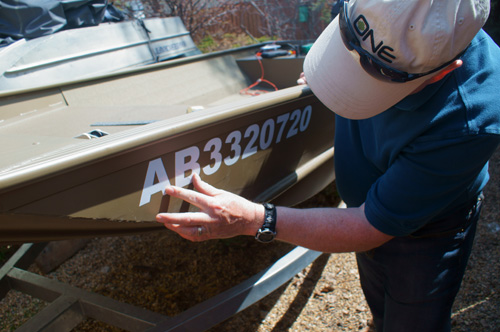
License numbers in place

My first step involved the installation of my pleasure craft license numbers.  As my new craft has a motor in excess of 10hp Transport Canada requires a pleasure craft license.  I must clearly display the license numbers on the sides of the boat above the waterline as close to the bow as possible.  The license numbers must be at least 7.5 centimeters (3 inches) high; and of a color that contrasts with the color of the boat.  Since my base color is olive I contacted a local printer and $20 later I was the proud owner of a set of white decals.  As my new boat was clean and new I easily installed the numbers along both sides of the boat.

I used a Scotty Anchor Lock for my rear anchor

Next, I installed my anchor cleats.  In my opinion anchor cleats are a must.  Deploying anchors should be a safe simple operation.  Fumbling around with cleats or tying knots to some part of the boat makes anchoring a challenge and should a fish decide to carry the fight around the anchors you will be hard pressed to raise them out of the way.

Removing the front access cover

I prefer pyramid anchors as they hold well on soft bottoms common to most lakes.  When guiding and instructing I often anchor broadside so 30 pound anchors fore and aft would be needed.  Anything less and I risked having the boat become an annoying distraction if it swayed or shifted in the wind.

Drilling the holes for the bow anchor

For the rear cleat I used one of Scotty’s indestructible anchor locks.  During the destructive testing phase of their development Scotty’s composite locks supported casting molds up to 200 pounds!  My 30 pound pyramid would not be a problem.  The Scotty Anchor Lock is probably the best on the market today.  I use them whenever possible on my boats and pontoon boats. 

Front anchor system in place

For the bow anchor I needed extension out from the boat so when moving from one spot to another the swinging anchor would not batter the boat.  John at River City Marine offers an excellent aluminum anchor system that easily removes for storage or covering the boat for transport.

On my new G3 access to the upper bow area is through a small access cover.  My youngest son, Sean still has long skinny arms.  I was able to con and coerce him to reach through the access hole to attach the stainless steel nuts and lock washers.  He did a wonderful job and didn’t drop one nut or lock washer.  I took over for the final nut and promptly dropped a washer into the bowels of the boat, so much for age and experience.

With the anchors installed I turned my attention to the bow seat.  The comfortable padded bow seat would be mounted on a 15-inch pedestal complete with recessed base.  The base required me to drill a 3.5-inch hole using a bi-metal hole saw through the upper aluminum deck.  Good friend Brian Chan has the same boat so I had a template to work from.  Brian provided me with the measurements from his boat which I transferred to mine.  Prior to drilling I did a test hole on a scrap of plywood to make sure the hole was wide enough to accommodate the recess of the pedestal base.  If it had been too small it would have been nearly impossible to make a 3.5-inch hole larger.  An ounce of prevention is worth a pound of cure!

The moment of truth, drilling the 3.5" hole for the front pedestal seat

I must have measured six times to be certain before committing to the drill.  I held my breath as the pilot drill of the hole saw began to turn and burrow through the deck.  If you have never drilled a large hole hold on tight to the drill.  When a large hole saws first bites into the aluminum deck the drill feels like it is going to be wrenched from your arms. Surviving the initial shock the first hole went perfectly.  I then had to drill a second hole through a support gusset directly below the first hole in the deck plate.  The pedestal base slipped into both holes.  Flush to the deck as advertised.
Prior to bolting the pedestal base in place I cut and fit a piece of black carpet runner to the upper deck.  I recommend carpeting all horizontal surfaces.  Carpet protects the boat from scratches and chips but more importantly it protects fly lines from being ground under feet and provides an element of stealth by muffling noise.  Water is denser medium than air, any clanging and banging about travels through the water alerting any nearby fish of your presence.

Melting the frayed ends of the front carpet

On my previous boats I glued the carpet down.  This time I wanted to be able to remove the carpet for easy cleaning.  Carpet runner has a heavy backing providing weight to ensure the carpet doesn’t blow away when the boat is running at top speed.  I cut a hole in the middle of the carpet section for the pedestal base and then melted the frayed ends using a barbeque lighter.

My son Sean sitting on the installed bow seat

My G3 came with a factory installed vinyl floor which at first glance seems quite fly line friendly.  If the boat hadn’t come with the floor I would have been fashioning a plywood floor and covering it with carpet as I had done for previous boats.  A plywood sub floor prolongs boat life, particularly riveted boats, by distributing weight and avoiding ‘oil canning’ issues.  Oil canning stresses rivets and leads to a never ending parade of leaks that always need attention.  On a traditional V hulled boat floor boards provide a flat comfortable base to stand on, both fore and aft.  Carpeted floorboards are a welcome addition to anyone who has spent any time in the bow area of a traditional V hull boat.

Measure twice, no five times, before drilling.

The last step for the day involved installing the rear pedestal.  As with the bow pedestal it required a 3.5-inch hole.  This time through the vinyl floor and the 1.5 inches of Styrofoam underneath the floor but obviously not though the hull.  All went well.  As I couldn’t bolt the pedestal base through the aluminum floor due to access issues I had to secure it to a 1/4-inch thick section of aluminum plate.  This plate was in turn secured to the floor and into the support gussets that run underneath the floor board.  I used #14 self-tapping stainless steel sheet metal screws.  As with the front seat I was working from a proven template from a friend’s boat.  The rear pedestal base is rock solid.

Phase one complete, now just the sounder and rear carpet left

By days end all was done.  I was sore, tired and a little sunburn in a few spots.  I still have to put the rear carpet, build a cover for the battery and engine compartment and install my new Hummingbird sounder.  Stay tuned for part two detailing these procedures.

By days end all was done.  I was sore, tired and a little sunburn in a few spots.  I still have to put the rear carpet, build a cover for the battery and engine compartment and install my new Hummingbird sounder.  Stay tuned for part two detailing these procedures.

Friday, May 4, 2012

3211Km and a Round Trip Airfare

During a two week portion of April I managed one round trip flight to Boise from my Edmonton area home followed a few days later by a 3211 Km (1995 miles) trip back down to Idaho to attend the East Idaho Tying Expo in Idaho Falls.  If you are wondering why I didn’t stay in Boise and then drive to Idaho Falls you are not alone.  Unfortunately sometimes how things come together isn’t always as neat and tidy as how it should have looked in hind sight.

If you like fly tying then the East Idaho Tying Expo is the place to be

The first part of my tale came together after the plans had been made and airfares purchased for the East Idaho Tying Expo.  Good friend Pete Erickson and I put together our first Fish Fest weekend in Boise.  Our Fish Feast concept broke away from the traditional workshop weekends where one has to typically invest their entire weekend to participate.  In today’s world this investment is not always possible. 

We offered a series of small half day seminars limited to just 10 students.  Pete provided hands on instruction in the art of long line Spanish/French nymphing and short line Polish and Czech nymphing. I provided a similar style program, Conquering Chironomids along with a hands on chironomid fly tying session. 

Pete Erickson at play!

On the Friday evening prior to the weekend’s events we kicked the event off with an informal get together.  Our mutual friend and world traveller Jeff Currier provided his Fly Fishing in the Presence of a Man Eater presentation.  Jeff is an excellent presenter and he had the audience on the edge of their seats as he told of his face to face encounter with a tiger while chasing mahseer in India a number of years ago.  I have heard Jeff’s tale a number of times and I still get a chill down my spine every time I hear it.

Chironomids were hatching, and lots of them!

Feedback was extremely positive from the event and the presentation format we chose. We are already making plans for 2013 including expansion outside of Boise to other states and provinces. 
As with most of my trips I managed to squeeze in some fishing.  Jeff, Pete and I were fortunate to be invited for some fishing on a private lake known for its large rainbows.  Chironomids were hatching, in impressive numbers.  Although we were in float tubes we didn’t have an anchor system.  It was tough to fish our imitations properly and it really limited how we could take advantage of hatch. Pete managed some nice fish using a type V sinking line to get his flies down quickly to compensate for the wind which proved brisk at times. I am a firm believer that you must have complete control of your presentation when chironomid fishing in order to be successful and this means fishing from an anchored position.  I did manage one nice fish using a floating line and a team of chironomids fished from shore.  A quick throat pump confirmed my suspicions, chironomids!  Based on my experience I made a note to myself for future trips to bring a portable anchor system.  I felt like a kid locked out from his favorite candy shop!

Average size rainbow

Within days of returning from Boise I was heading south once again, this time in my truck for the East Idaho Tying Expo.  Long-time friend Brian Chan was joining me. I picked up Brian from the Calgary International Airport on my way south.  Brian had made his flight bookings prior to my Boise trip so I had to return home in order for our plans to work out.  Together we headed south through Montana on I-15 as it snaked along the banks of the Missouri River, crossing the Bighorn and then the Beaverhead near the town of Dhillon.  On the return trip home, Brian and I stopped in Craig Montana on the banks of the Missouri and poked around the three impressive fly shops there.  We made a point of promising to set aside a day to try our luck there next year.  By 9:30pm we were in Idaho Falls.

Brian and I enjoyed ourselves at the Tying Expo.  It was well attended and we bumped into a number of friends including John Rohmer from Arizona Fly Fishing, authors Jim Schollmeyer and Dave Hughes.  Jim and Dave were on their way to the Bighorn and used the tying expo as a stop to catch their breath.  Their trip to the Bighorn would take them 24 hour s from Portland.  It seemed like everyone wanted to cover some distance in April.

While at the expo, Brian and I provided two separate four hour tying seminars where we provided hands on instruction on how to tie some of our favorite lake patterns.  We also provided a couple of on camera tying demos and seminars.  The Snake River Cutthroats club did an excellent job organizing and hosting the event.  Brian and I are hoping to return next year.

Foot in the Henry's Fork, another river off my bucket list.

During our stay we were fortunate to fish one of the waters on my bucket list, the world famous Henry’s Fork.  John Harder, President of Rio Fly Lines was our host. We fished the region upstream from the famed Harriman Ranch section, which was closed, near the small town of Last Chance.  I stood knee deep in the Henry’s Fork within eye shot of Rene Harrop’s Trout Predator and Mike Lawson’s Henry’s Fork Angler.  Two fly shops synonymous with the Henry’s Fork.  Unfortunately the river flow had been increased from 900 cubic feet per second (CFS) a few days earlier to roughly 1200 CFS and the fishing was off.  I hooked, and lost, one good rainbow while managing to land two whitefish.  It didn’t matter to me.  John was a wonderful host pointing out different features and aspects of the region.  I was just happy to be on the water drifting nymphs through the flows of one of the world’s most famous streams.

Looking downstream toward Harriman Ranch

Our trip culminated with a day on Chesterfield reservoir near the town of Pocatello, Idaho.  Chesterfield is one of Idaho’s best stillwaters, known for producing large rainbows.  Upon our arrival we were greeted by a chorus of yellow headed blackbirds, a beautiful sunny day, high clouds and light winds.  Brian and I were there with Simon Gawesworth and Zack Dalton from Rio.  While we were there we focused on some website content for Rio. Brian and I are both on Rio's Advisory Team.  As a result, we didn’t really get focused on fishing until later in the day.  When we did hook a fish a quick throat sample revealed heavy feeding on chironomid pupa.  One fish I pumped had a leech, one damsel fly nymph and at least 75 active, wriggling chironomid pupa.  Brian and I were impressed with what we saw at Chesterfield and hope to return soon.

Brian, Simon and Zack preparing for the day on Chesterfield Reservoir.

Although long and tiring at times, I thoroughly enjoyed my Idaho experience.  I look forward to returning for a stillwater seminar planned for July 13-14.  We will be based out of Island Park Lodge and targeting Henrys’ Lake, possibly Island Park Reservoir and we will have one day’s access to Sheridan Lake.  Sheridan is a private trophy lake.  Last year the damsels were coming off in staggering numbers.  You can check out last year’s blog entry to get an idea.  Seminar size is limited to just 10 people to ensure the best learning environment.  If this seminar is of interest to you please let me know and I can pass along the course info.

Brian at play on Chesterfield Reservoir.

I am now busy getting my new 1756 VBW Yamaha G3 all primed and ready for the new season.  Watch for some future entries dealing with how I customize my new boat for stillwaters.

Thursday, April 5, 2012

Vancouver Island Chironomids

This past weekend I managed to finally sneak out on the water for the first time in 2012.  Previous speaking engagements had shown promise for a little on the water excursion but Old Man Winter always had other ideas. 

My weekend began at Robinson’s Outdoor Sports where I held a comprehensive 2-day Conquering Chironomids seminar.  Saturday was packed with over 55 people in attendance.  We focused on chironomid strategies and tactics including life cycle, equipment, leader setups, floating line techniques, sinking line techniques, dry and emerger tactics, presentation tricks and retrieves.  Sunday was all about tying.  Students were provided with all the necessary materials to tie an array of patterns covering all aspects of the chironomid life cycle.  The Stillwater Hopper with its knotted pheasant tail lakes caused a few heavy sighs but the 18 students did well and we managed to crank out some 14 patterns over the course of the day. 

Stillwater Hopper, A Great Emerger Pattern

As soon as the class had finished I packed up and was on my way to Cowichan River Wilderness Lodge located on the banks of the Cowichan River.  Good friend, lodge owner and creator of Eyes N Tubes Kenzie Cutthbert and his wife Kyt had been trying to have me spend some time with them for a few years.  This trip we were finally able to connect.

The River Was High But Clear

Kenzie and Kyt have a beautiful lodge nestled amongst the trees just a short walk away from the Cowhichan River.  The Cowichan is a top class river known for its rainbow, cutthroat, steelhead, coho salmon and unique population of brown trout, a rarity in British Columbia. 

Nice To Launch and Finish Where You Started!

The Cowichan River flows out of Cowichan east to where it eventually spills into the ocean at Cowichan Bay. Kenzie’s lodge is located about mid-way through one of the most popular drifts on the river from the town of Lake Cowichan to Skutz Falls.  About half of this drift, from Lake Cowichan to the train trestle bridge just below Kenzie’s lodge is designated fly fishing only water.  Artificial flies only, no external weight on the leader or indicators are allowed. 

We began our day just after 8am drifting down from Kenzie’s backyard towards Skutz Falls.  At this time of the year rainbows, browns and steelhead are all available.  The water was high but clear and during our drift it was common to see pods of large steelhead, rainbows recovering from their recent spawn and the odd brown trout.  By roughly one o’clock we had finished our drift down to Skutz falls.  We had each caught a number of rainbows and browns using some of Kenize’s unique Eyes N Tubes Muddlers and egg patterns. 

Sight Fishing on the Cowichan

Kyt picked us up. We quickly loaded the boat and made our way back up to the town of Lake Cowichan.  The drive took all of 10 minutes.  We put the boat in just below town in a spot Kenzie christened the aquarium.  Crystal clear water and loads of fish to stare at, steelhead and rainbow where everywhere.  We managed to catch and release a few rainbow as we were targeting trout, brown trout to be specific, we left the steelhead for another trip. 

About a mile or so downstream we tucked into a large slow back eddy.  It was almost slough like.  We dropped anchor and began to probe likely looking areas with Kenzie’s Muddled Buggers.   Within a few casts Kenzie was into our first brown.  Time seemed to waste away.  We must have spent two hours working that back eddy catching a number of decent browns.  We even had a few titanic looking steelhead cruise by as they used the back eddy as a resting spot before heading further upstream.  If we had accidently hooked one of those fish it would have proved to be a short, savage, struggle on our six and seven weight rods.

Kenzie's Muddled Bugger 1 Brown Trout 0

Looking at our watches we ended having to rush a bit more than we would have liked to make it back down to the lodge.  I have done countless drifts on many rivers but ending up where you started from was unique and put the cherry on my Cowichan River experience.

Muddled Buggers Work for Me Too!

If your travels ever take you to southern Vancouver Island make sure to give Kenzie a call to see if he is available.  Make a point of booking time at his lodge, the food and accommodation is first class!  Kenzie and Kyt provide a wonderful experience. In addition to the Cowichan Kenzie has access to other great rivers such as the Nitnat and San Juan and some little known world class smallmouth bass fishing. 

For more information on Kenzie’s Fishing Adventures, Cowichan River Wilderness Lodge and his Eyes N Tubes system please visit their respective links.  Kenzie and I are already making plans for future trips.Lake

Friday, March 9, 2012

Join Me This Season

Earlier this week I completed a journey that began with one of those white knuckle blowing snow limited to no visibility drives.  The kind of trip that starts safe and sound.   But when you are almost in the exact geographical center between home and your destination Mother Nature batters you with a vengeance.  While focusing on the task at hand, driving, and making sure that the taillights I am following aren’t disappearing to some off road, in the ditch, destination thoughts of being somewhere else such as on the water crossed my mind often.

Can you say fun drive!
I enjoying providing stillwater workshops and seminars across North America including many of the ‘on the water’ variety.  Each year around Christmas I post the seminars and workshops I am aware of up on my website calendar.  In the past I have had people express disappointment that they weren’t aware of my seminars or just forgot to check back on my calendar.  In order to alleviate any missed opportunties here are the workshops and seminars in chronological order I have planned for 2012.

Made it to my first destination
I have included a brief description of each seminar, pricing, dates etc.  In addition, I have provided links to specific websites or informational documentation for each course.  If any one of these seminars or workshops is of interest please let me know right away as many of them feature small class sizes for maximum interaction and learning.  If you check my calendar you will see that a number of workshops and seminars have already sold out.

Stillwater Secrets and Beyond Seminar, Ottawa Ontario, March 17-18, 2012-
This is a two day seminar consisting of a full day seminar on Saturday including a variety of stillwater techniques, hands on knot tying and Euro nymphing.  Sunday features a hands on fly tying seminar with all materials provided less basic tying tools and some spooled products such as thread, Mylar and wire.  Costs are $50/day or $90 for both days.  There are still a few spots available, please send me and email to book your spot.

Conquering Chironomids Weekend Seminar, Robinson’s Sporting Goods, Victoria, B.C, March 31-April 1, 2012.-This comprehensive 2-day seminar covers both tactical stillwater chironomid presentation techniques and hands on fly tying.  The presentation techniques seminar takes place on Saturday, hands on fly tying Sunday.  All tying materials less basic tying tools and spooled products such as thread Mylar and wire are included.  Costs are $40/day or $75 for both days.  To book a spot please contact Robinson’s Sporting Goods, 1-888-317-0033.

BC Outdoors Sports Fishing Learning with the Pros Seminar and Workshop with Brian Chan, Kelowna B.C., April 28-29, 2012.-
The Learning with the Pros seminar format has been a popular choice for many.  Good friend and colleague Brian Chan and I will be providing a one day techniques seminar followed by an all-day hands on tying seminar.  The tying seminar includes all materials less basic tying tools and spooled products such as Mylar, thread and wire.  Costs are $100/day or $180 for both days.  To book a spot please contact Kim Crawford at B.C. Outdoors Magazine, 604-464-1876 or via email.

Spectacular food and accomodation along with access to a number of private lakes awaits those who visit Falcon's Ledge
Stillwater Fly Fishing School, Falcon's Ledge, Altamont, Utah, Friday, Saturday and Sunday, May 18-20, 2012-This the second season I have offered an on the water stillwater fly fishing school at the luxurious Orvis Endorsed Falcon’s Ledge.  We have access to private waters teaming with rainbows, browns and tiger trout.  This particular seminar will have a definite chironomid, mayfly and damselfly focus.  Class size is limited to 12 students only.  To book a spot please call Falcon’s Ledge at 877-879-3737.  Seminar price includes all food accommodation, class room and on the water instruction.

Conquering Chironomids Fly Fishing School, Fortress Lake Wilderness Retreat, Fortress Lake, B.C., June 18-June 22, 2012-
This weeklong school takes place on one of most spectacular stillwater venues in North America chasing trophy brook trout using a variety of chironomid techniques.  At this time of the year the chironomid hatch on Fortress should be in full swing.  Emerging adults blanket the water like snowflakes.  Fortress Lake provides a rare opportunity to hone a variety of floating and sinking line techniques.  Costs for fly in are $2895 and includes flights from Hinton, AB, food, accommodation, classroom and on the water instruction.  A hike in option priced at $1875 is also available.   To book a spot please contact Fortress Lake Retreat at 403 346 1698 or email.

Henry's Lake Cutthroat
Idaho Stillwater School, Island Park Lodge, Idaho, July 13-14, 2012-The Island Park region offers some outstanding stillwater opportunities.  This comprehensive stillwater school includes one full day on Sheridan Lake.  Sheridan is a private lake trophy lake.  I have personally taken rainbows to 9 pounds.  We will also spend time on legendary Henry’s Lake and Island Park Reservoir.  The school is a blend of both class room and on the water instruction.  At this time of the year, chironomids, mayflies and damselflies should be in full swing.  Costs are $595 and include access to Sheridan Lake.  Accommodation and food is extra.  Class size is limited to 10 sudents only.  To book a spot please contact Lynn Scott at BS Flies via email or call (208) 390-2177.

There are few places as scenic as Fortress Lake
Fortress Lake Sight Fishing School, Fortress Lake Wilderness Retreat, Fortress Lake, B.C., Monday through Friday, August 27-31, 2012-during the late summer Fortress Lake is crystal clear providing some unbelievable sight fishing opportunities.  Watching a trophy brook trout rush and engulf your streamer or delicately rise to a dry fly is heart stopping.  Through both classroom and on the water instruction students will learn a variety of skills such as how to spot and approach fish along with equipment considerations for sight fishing.  This type of fly fishing is addictive so be warned.  Costs for fly in are $2895 and includes flights from Hinton, AB, food, accommodation, classroom and on the water instruction.  A hike in option priced at $1875 is also available.   To book a spot please contact Fortress Lake Retreat at 403 346 1698 or email.

Prowling the Parklands Weekend Stillwater Seminar and Hosted Trip, Russell, Manitoba Region, September 13-17 2012 (three full days on the water) and September 17-23, 2012(five full days on the water)-The southwest corner of Manitoba offers arguably the best stillwater fly fishing in North America.  These rich productive lakes are home to large often huge rainbows, browns and tiger trout.  At this time of the year trout will be gorging on leeches, scuds, water boatman, backswimmers and vast quantities of forage fish.    The three day trip costs $695/person, 5 day trip costs $1150/person and includes accommodation, food, seminars, and one on time with me on the water.  My June trips booked before I had a chance to advertise and fall is already starting to book.  These are popular trips.  To book a spot please contact me via email.

Hopefully you might be able to fit one of my seminars or workshops into your open water schedule.  If you need any further information at all please do not hesitate to contact me via email.