Saturday, July 17, 2010

Casting Indicators on Stillwaters

This past week, I spent some time on a local private pond courtesy of a friend.  These waters were mere minutes from my house and proved a welcome change.  Small personal ponds like the one I fished allowed me to fish from shore, a rarity for most of the lakes and ponds I fish.  Often there is little or no back cast room or the bottom is so soft that one step into the shallows could be your last.


I chose a two fly set up, a damsel nymph on the point and a Pearl Shrimp on the dropper.  When I looked around the shallows I saw a fair numbers of small scuds scurrying about and the odd damselfly nymph. Recent throat samples confirmed that the fish cruising the margins were picking of stray scuds who ventured too far from the protection of the weedy carpet that covered the lake floor.  At one point I swapped the Pearl Shrimp for a #12 gold bead Pheasant Tail (GBPT) and started hooking fish consistently.  Landing them proved to be another issue at times but enough came to hand to keep me satisfied.  I figured the added weight of the gold bead got the fly down deep enough.  With about half an hour to go I finally relented and swapped up to a balanced leech beneath an indicator, a presentation method that has proved to be perhaps my most consistent producer.  For my guide trips earlier this year suspending leeches or chironomids below an indicator has proved itself to be the right choice time and time again.

(Photo courtesy of Nick Sliwkanich)

Most people casting indicators on stillwaters often get themselves into trouble in regards to tangles.  From my observations this is a result of trying to cast too far.  My preferred line for this method without a doubt is Rio's Indicator line.  This weight forward line features a light green front section and an ivory running line.  Its construction and configuration is all about casting indicators and the paraphernalia that seems to accompany them.  The junction of these two colors is the maximum you need to cast.

(Photo courtesy of Nick Sliwkanich)

Repeated false casts is one of the primary causes of tangles.   Modern weight forward lines are designed to shoot to the target.  Unlike the multiple false casts common to casting double taper lines, let the weight forward section load the rod and then shoot the line to the target.  Keep in mind, the slender running line behind the weight forward section is not designed to false cast, it is intended to shoot.   An indicator, swivel or split shot and a couple of flies, where permitted, is not a natural combination for a fly rod. It tends to fight back.  Reducing the casting distance reduces false casts there by lessening the tangle factor.  In addition the closer you are to your indicator the better able you are to see the subtle strikes that would not be visible at distance.  Using a smaller indicator keeps you honest too.  Use powerful smooth stroke and avoid 'punching' the line as this leads to tailing loops and tangles. Watch your back cast.  Make sure it unfolds completely behind you so the energy transfer from your casting motion can take place.

Finally, if you are using a Quick Release Indicator place the plastic peg on the fly side of the indicator.  This placement results in less tangles as the tippet and flies roll away from the indicator.  If you through a tailing loop it should not catch the peg.  When using Quick Release Indicators place a small swivel between your indicator and fly or flies, it provides a number of benefits.  The swivel acts as a stopper and should you break off the dense black peg will not slide off the leader and sink.


In many instances the short distances best suited for success can be covered with a roll cast. When hanging flies in deeper water, say over 10 feet, you may have to roll cast the line successively to cycle the fly or flies up through the water column.  Once clear of the water make one false cast and allow the weight forward line to do what it is designed to do, shoot to the target.  As the indicator and flies land watch for the distinct separate plops of the flies or flies, swivel and indicator.  If they land within inches of each other, strip in and investigate.  The tangle is often in its infancy and can be quickly cured.  Pinching the line or allowing it to shoot tight to the reel slingshots the indicator and flies providing the necessary separation for proper presentation and reduced tangles


To summarize;
  1. Avoid excessive false casts. Let the weight forward line do what it is designed to do.  No more than two false casts and shoot to the target on three.  After some practice you should be able load the rod with one false cast and shoot to the target.
  2. Try to cast only the weight forward section of your fly line.  Watching your indicator from a distance is not necessary and in many instances you miss subtle takes.  Not all indicators are the firm bubble trails to the depths we dream off.
  3. Let your back cast unroll in the same manner as the front cast to ensure complete energy transfer.  I am bad for this one at times!
  4. Place the indicator peg when using Quick Release Indicators on the fly side of the indicator.  The unfurling leader and flies has less to catch in the event of a tailing loop.
  5. Pinch the line or allow the it to shoot to the reel to slingshot the indicator, swivel and flies or fly over.  Look for separation between the components as a clue to a tangle free cast.
Dangling chironomids, leeches, scuds and other patterns beneath an indicator is deadly.  Particularly when fish seem dour and unwilling to chase a fly moving at a faster pace, such as when water temperatures are cool or unsettled weather disrupts normal feeding activity.  The next time you are struggling with your indicator setup consider these tips.  You should hopefully spend more time watching your indicator disappear beneath the surface than fumbling with a frustrating tangle that might have been prevented.

Monday, July 12, 2010

Some Fish are Meant to be Caught!

Last Thursday evening I accompanied Dave and Amelia Jensen as we prospected a central Alberta stream.  We were scouting potential location for an upcoming episode of The New Fly Fisher which I will be filming with Dave and Amelia along with Tom Rosenbauer from Orvis during the week of July 19th.  Our goal for the evening was to drift and search for snouts sipping quietly along the river's edge.  As there was goldeye in the river as well I had to learn to distinguish the difference between the somewhat aggressive concentrated rises of gold eye verses the individual slurp of a large brown.

(Photo Courtesy of Amelia Jensen)

The brown trout population is sparse so a keen eye was required by all.  It is amazing how subtle rises can pass unnoticed if you are not prepared to look and study a section of water.  Just as darkness approached we found a small number of browns rising along the edge of a high grass bank.  As Dave had yet to cast to a trout it was his turn.  Amelia and I had targeted a couple of risers with no success earlier in the evening.  Dave made one cast and as his fly drifted into the trout's window it disappeared in a confident deliberate rise.  After a spirited battle the large, 25-inch plus brown lay at our feet.  She was, beautiful fat and healthy.


Another trout rose a few yards upstream from where Dave had taken his gorgeous brown. Now it was my turn.  Since my rod was downstream in the boat Dave offered me his rod.  After all, his large brown drake imitation had already proven its worth.  Up steps challenge number one.  Dave prefers double taper lines, I have been using weight forward lines for years. I didn't realize this right away and it took me a number of casts for me to get used to casting a double taper once again.  Finally I was able to get the distance and accuracy needed to cover the fish.  My fly drifted down to where we had seen the fish move and it was taken in a gentle deliberate slurp.  I let the fish take the fly and game on.  Up steps challenge number two.  As the fish bolted I realized that Dave's reel was set up for right hand retrieve.  As lefty hybrid who casts right handed, the product of being brought up in a right-handed world, my reel is set up to retrieve left handed.  I was not able to gather line and control the fish as I would have liked.  Up steps challenge number three.  Another fish was rising upstream of this fish so I did not want my fish to spook that fish as Amelia was next up to bat.  Due to my trying not to have the fish bolt upstream and my battle trying to reel right-handed I was not forceful enough with the fish and it forged its way out into the main current and proceeded to wrap itself around a rock.  The fish was still attached as I could feel it throbbing through the line.  Now what?  Well thankfully, at over 6-feet tall, Dave offered and was able to wade out and above the fish and free the line.  Game on again.  Up steps challenge number four, my final challenge.  Now the fish took off down stream and decided that under our anchored boat was good place to go.  The leader rubbed against the anchor rope which we were able to free and not soon after the fish was in the net resting and recovering before being released.

(Photo Courtesy of Amelia Jensen)

I couldn't believe I had been fortunate enough to land this fish.  By all rights I should have lost it on at least three or four occasions.  I guess some fish are just meant to be caught.   The moral of this story is to use your own equipment or at least get comfortable with and know what you are borrowing before going live!

Amelia stepped up to bat after my adventure but darkness had taken over and the swarm of mosquitoes was intensifying with every minute despite our multiple applications of bug juice.  I felt bad as my bumbling had consumed valuable time and daylight.  Next time Amelia goes first!

Wednesday, July 7, 2010

Good Press!

They say any publicity is good publicity.  Thankfully some recent publicity has all been good, both on a national and regional scale. 

As most of you are probably aware, a number of years ago Brian Chan and I partnered with Superfly International, a Canadian based  fly tying and equipment distributor, to create the Stillwater Solutions line of tying materials and flies.  In the Summer issue of Fly Tyer magazine you can find an article by Jay Jacobs on the Stillwater Solutions product line.  Jay interviewed Brian and me on a number of topics including the product line, how it came to be and our thoughts on stillwater fly design.  If you can't get on the water perhaps picking up this issue might lessen the pain.  This issue as with others contains a number of excellent fly tying articles. 


When I was down speaking at the Pleasanton Fly Fishing Show in February I was overwhelmed by the response.  The crowd was interested and enthusiastic about stillwater fly fishing and the particular topics I presented.  After one of my shows a gentleman by the name of Bill Forward approached me and asked if I would be interested in providing an interview for his regional magazine the Sierra Fisherman.  Bill has fly fished California for over 35 years and is a former biology instructor. In addition to his editorial duties with the magazine he also provides guiding and instruction through his guide company, Forward Bound.

The interview contained in the summer issue is entitled the Wisdom of the Cast consisted of my answering a series of specific questions regarding stillwater fly fishing.  If you have access to this free publication hopefully you had a chance to catch the article, if not if you can find the article here.


The Sierra Fisherman is a neat regional publication serving the Sierra region of California.  Regional magazines such as this offer unique tips and techniques along with a number of fly patterns.  If you ever travel make a point of searching out these local magazines as the information they contain often has a far greater reach than their geographic region. 

On a final note I will be down in California this fall and will be providing a stillwater seminar  in Graeagle, CA, October 15, coupled with a lakeside program on the 16th (Lake Davis). I am looking forward to sampling some of the excellent stillwater fly fishing opporutnities Lake Davis has to offer.  Enrollment is limited and discounts on lodging are available. For more information or to register please contact Forward Bound at (530) 836-0206 for more information.

Saturday, July 3, 2010

Learning With The Pros

Well June has come and gone. It proved to be one of the busiest months I can ever remember.  My seminar trail took me to Manitoba, Fortress Lake and this past weekend in British Columbia for a Learning With the Pros Seminar.  Brian Chan and I, in partnership with BC Outdoors Sport Fishing magazine, have been providing weekend Learning With the Pros stillwater seminars at a variety of B.C. locations for the past three years.  This year we based ourselves at Tunkwa Lake and Tunkwa Lake Resort.


Tunkwa Lake Resort was an excellent location, easy to get to and the hospitality they provided to our group made the weekend an even greater success.  It had been a number of years since I last stayed at the resort and the improvements they have made are quite noticeable.  Especially the new cabin we stayed at.  Our cabin was a beautiful clean facility that can easily sleep 12.  It comes complete with two full sized bathrooms, large kitchen and dinning area.  It was the perfect place to unwind and relax at the end of the day.


Brian and I had over 30 people attend this year's event, another complete sellout. We provided seminars on a wide variety of subjects including chironomids, leader construction, sinking lines and lake biology to name a few.  I really enjoy the interaction and discussion these seminars provide.


While the learning was good the fishing was not unfortunately.  Tunkwa Lake is at full pool and the high water in conjunction with a full moon really had the fish out of sorts.  The lodge reported that they had a really unsettled wet spring and the lake was not where it usually was for late June.  Brian and I both noticed how clear the lake was.  In late June the seasonal algae bloom is usually in full swing.  The water was still quite clear for Tunkwa.  Not everyone caught fish, over two days I only managed to shake hands with two fish and Brian managed to land only one!  We tried a variety of tactics and had our best success, if you can call it that, suspending small leeches and chironomid patterns below an indicator.  It was tough to get fish to chase a fly.  We had one person drift by us on the Saturday passed out in his boat, working on his tan.  In hindsight he may have had the best strategy!


The Learning With the Pros event sees a new expansion for 2010 with the addition of an advanced seminar format.  The advanced session is intended for past Learning with the Pros attendees and any fly fisher looking to improve their stillwater fly fishing skills and knowledge.  The advanced event is slated for for October 1-3 at Stoney Lake Lodge located on the Douglas Lake Ranch.  Stoney Lake Lodge is a beautiful place to stay offering deluxe accommodation, great food and the trophy lakes Stoney and Minnie are minutes away.  Actually, Stoney Lake is mere seconds away! The large trout Minnie and Stoney Lakes are noted for will be cruising the shallows, aggressively stocking up on just about anything they can chase down for the long cold winter ahead.  Fall is the time for the largest fish of the season and we should experience some exciting fishing.

In addition to personal one on one time with Brian and I on the water here is a sample of what we will be covering.
  • Hands On Leader Construction
  • Advanced Lake Limnology
  • How to Fight Big Fish
  • Advanced Floating Line Techniques
  • Presentation Secrets
  • How and When to Use Attractors
  • Tactics and Techniques for Tough Days
Brian and I will also be providing on camera tying demonstrations detailing some of our favorite patterns.
There are only 14 spaces available and I know some spots are already taken.  Cost for the weekend is $850/person and includes food, accommodation & courses.  To reserve your spot or for additional information please don’t hesitate to email events@bcoutdoorsmagazine.com or call 604.464.1876.

Please contact myself or B.C. Outdoors Sport Fishing magazine right away if you are interested.  I know a number of the students from this past weekend were keen on signing up.

Monday, June 28, 2010

Simply Spectacular!


My latest trip had me at Fortress Lake Wilderness Retreat nestled amongst the spectacular Canadian Rockies along the B.C. Alberta border.


Although I have had the pleasure of fishing Fortress in the past this is my first since Dave and Amelia Jensen took over.  While I was there I thoroughly enjoyed the world class trophy brook trout fishing Fortress is renowned for but also provided one of my comprehensive stillwater seminars.


Fortress Lake is not easy to get to.  It can be accessed by mountain bike and hiking but it is not a trip for the faint of heart.  The route in takes over three hours to complete and involves crossing the Chaba River and traipsing through grizzly country.  The Rockies abound with these magnificent creatures.  I chose the easier option, a scenic 45 minute flight on a Jasper Air Cessna 185 on floats.  My only complaint regarding the flight is that it is too short.  The route out of Peppers Lake near the small town of Hinton to Fortress Lake is spectacular.  After leaving Peppers we headed west to Jasper, turned south along the Athabasca River and then hung a right at the Chaba River and west into Fortress Lake.  Throughout the flight I was going crazy taking pictures of snow capped peaks, rugged ridges and scenic lakes along the way.


As Fortress Lake swings into view the lake’s ice blue coloration provides a beautiful contrast to the adjacent ridges and peaks.  As Fortress Lake swings into view the lake’s ice blue coloration really stands out.  Within minutes of first viewing the lake we were taxing up to the dock at Fortress Lake Retreat. Our trophy brook trout experience was about to begin.


Dave, Amelia, Nick and Dustin were at the dock to great us.  Our luggage was quickly removed from the plane and distributed to our respective cabins.  Since my last visit Dave and Amelia have made a number of significant improvements to the facilities.  The cozy tent cabins complete with queen size beds, cozy comforters and small wood stoves still remained.  No reason to change these.  Additional yurts have been added including a full shower house complete with on demand hot water and a dinning room complete with leather couches.  The dinning yurt was a perfect venue for the PowerPoint seminars I provided on a daily basis.  These new yurts are spacious and well lit.


Perhaps Fortress Lake Retreat’s most unique features are its two washrooms complete with squeaky clean flush toilets.  The washrooms face away from the rest of the camp.  This is for good reason as they have no doors.  A simple turning of the fish signs to the horizontal signifies the facility is in use.  The view from the bathrooms is spectacular as you gaze upon snow capped peaks. If you are lucky the rumble of small avalanches catches your attention. The snow tumbling down the mountain side rounds out your ‘biological experience’.  Dave also makes a good point, should a bear show up while you are taking care of business you are definitely in the right spot!


After a quick tour and orientation we were soon scrambling about getting gear ready and  getting into one of the lodges comfortable aluminum boats complete with 4 stroke outboard motors.  The waters of Fortress are crystal clear most of the year with the exception of a couple of weeks in July when the freshet swollen waters of Chisel Creek cloud the lake with glacial till.  The crystal clear water provided an excellent environment for some impressive underwater shots with my Pentax Optio camera.


Dave suggested we head down to the west end of the lake and within minutes our convoy of aluminum boats was motoring down the lake.  When traveling down the lake from spot to spot it is difficult to focus your attention on your next destination as the spectacular scenic vistas promote long periods of gawking and amazement.


The debris fields left by avalanche chutes are impressive as boulders the size of small houses litter key spots along the shoreline.  These areas are proven brook trout haunts.


Fortress Lake’s trophy brook trout are a naturally sustained population first introduced by Jasper Park rangers in the 1930’s.  These Coaster strain brookies average 3-4 pounds. Five to seven pounders are a daily occurrence.  They are beautiful silver blue with odd darker fish decked out in traditional brook trout color schemes.  I have to admit a preference for the nickel bright variety.  Once landed, Fortress Lake brookies are hard to hold. The large ones in particular seem to be camera shy but we managed to get a few to pose for the camera.  Brook trout are not known for their searing runs as rainbows but they still pull line and bulldog and struggle, significantly testing both your mettle and equipment.

 
What amazes me about Fortress is its productivity.  During our stay I was amazed by the size and intensity of the chironomid hatches.  Throat pump samples revealed that the brookies were keyed into this protein enriched bounty.  One sample from a 4-pound fish revealed over 200 wriggling pupa!   One of our most productive approaches during our stay was suspending size 10 and 12 black and red Ice Cream Cones 18-22 feet below an indicator.  Hanging chironomids at this depth is near the limit of practical indicator fishing and my Quick Release indicators proved their worth.


Thankfully, brook trout tend to be more gregarious than rainbows in their feeding habits than rainbows. If staring at an indicators required a break casting and stripping leech and baitfish patterns provided a welcome alternative.  Fast sinking lines from type 3 through 6 proved most effective.  After making a long cast letting the fly sink from 15-20 seconds worked best for the 18-24 foot water we were working.  A quick glance into the shallows often revealed large brookies cruising the shoreline rocks and sunken debris.  If you could get a fly down to them a firm take often followed.  Sight fishing with fast sinking lines is unique and exciting.   Barry and Pauline from my group did well on a number of occasions casting and stripping small size 4 and 6 brown over white Clouser’s.  Fortress Lake is a mono culture fishery and brook trout are the only inhabitants.  As a result, immature brookies are a favored prey item of the larger residents.


Our four day adventure was blessed by gorgeous blue skies and great weather.  We only had a brief wind whip up the lake for a couple of hours on our last full day. As I recall I only got the rain gear out for a couple of hours in total as a few rain squalls traveled down the length of the lake.  The stillwater school itself was a success and I am already looking forward to providing schools again in 2011.  Next year’s schools will include two options, a four day weekend session running from Friday through Monday, and a comprehensive week long session from Monday through Friday.  Students are provided with morning and evening sessions covering a variety of stillwater strategies, tactics, equipment preferences along with daily debrief sessions to ensure everyone is provided with a complete stillwater experience.  If anyone is interested in either of these schools for 2011 please let me know.  Fortress Lake is a spectacular place to hone your stillwater fly fishing skills.

Thursday, June 10, 2010

Prowling the Parklands

I just returned from four days of some of the best stillwater fly fishing I have ever experienced.  Preparations for this journey began back in April when I provided a one day informational session and fly tying clinic for ten of the 12 anglers I would host on a trip to explore some of the quality lakes located in the south west corner of Manitoba, near the towns of Russell, Roblin, Oakburn, Rossburn and Sandy Lake, better known to many as the Parklands.


From my Edmonton area home the drive took approximately nine hours punctuated by strategic Tim Horton's stops for a stretch and caffeine top up.  Driving across rural Saskatchewan has a relaxing almost therapeutic effect on me.  You have lots to see as nothing is there to block your view.  Just outside of Saskatoon I had to stop and snap a picture of Combine World.  A dealership dedicated to selling both new and used combine harvesters.  I knew I was in Saskatchewan for sure after this sight.


The group arrived around dinner time on the evening of Friday June 4 in groups of two to four anglers. We based ourselves at Arrow Lake Lodge near the town of Rossburn.  Arrow Lake Lodge is strategically located amongst some of the finest trout fishing in the region.  The facilities are perfect for large groups.  The main cabin we were primarily occupied in sleeps up to 10 people.  The large dinning room table seats up to 16 and was a perfect platform for my evening lectures. Ray Lazaruk from Arrow Lake Lodge was a pleasure to work with.  I strongly recommend booking a stay, especially if you are part of a larger group of fly fishers.  A word to the wise though, book early, Ray's lodge is popular with both anglers and hunters throughout the year.


After settling in and devouring a healthy dinner of barbecued smokies I provided two seminars to get the group prepared for our first day on Tokaryk Lake.  Each evening I provided seminars after dinner along with a detailed de-brief session to review the key lessons learned from the day's experiences and to set up the following day.  It was a format that proved quite successful.  On the last evening we gathered around my lap top and pluged in cameras and digital cards for a photographic review of the trip.  It was the perfect conclusion to a fantastic trip.

Day 1-Tokaryk Lake


Based upon reliable reports we targeted Tokaryk Lake for our first day.  My personal thoughts were that if Tokaryk Lake fished well it would provide an element of confidence to tackle some of the more fickle waters we would visit in the following days.  Tokaryk did not disappoint.  In fact it excelled to the point of mythical.  The day started with a threat of rain and it did open up for a short while in the early afternoon.  The clouds broke soon after and I had the raccoon weather marked face to prove it! I started by making a few initial stops in the shallow reaches of the lake.  With nothing to show for my efforts I moved to slightly deeper water and suspended a brown and copper Ice Cream Cone beneath one of my balanced Sparkle Leeches.  It didn't take long to get a response.  The indicator drew under and when I set the hook all went crazy.  About five pounds of nickle bright rainbow exploded on the surface and tore line from my reel at breakneck speed.  After a prolonged battle I felt fortunate to have the magnificent fish lying beside my boat in my Moby net.  I removed the Ice Cream Cone from its upper jaw and stared at the beauty of this fish.  It was as bright as a chrome bumper, beautiful fat and perfectly conditioned.  Tokaryk fish are so bright that they over expose if you are not careful when taking pictures as evidenced below.  It was going to be a good day. 


Two members of our group, Andrew and Wade had anchored themselves in about 14 feet of water, drawn there by the number of low flying birds working the area.  They proceeded to put on a clinic using chironomid patterns.  They had numerous double headers and I managed a few shots of their 'Tokaryk twins'.


Chironomids were hatching in numbers and the trout were definitely keyed into them.  I joined Andrew and Wade and had a fantastic day taking over 20 fish to 8lbs on chironomids and balanced leeches.  Tokaryk fish are gorgeous, large and strong.  On two occasions I was snapped off by headstrong fish.  The last time resulted in my forgoing the indicator and fishing perhaps my favorite method, a floating line and long leader.  Nothing beats the take of a trout using this method.  I finished my day reluctantly at 6pm as dinner beckoned and I had to prepare for my evening session.  I was fortunate that the lodge was about 15 minutes away.  I capped my day with one of Tokaryk's browns but I have to admit I was smitten by the 4lb average nickle bright rainbows.  What a start to the trip, everyone had similar results to mine and for many they caught some of the largest rainbows of their lives.

 
Day 2-Patterson Lake

Patterson Lake, an even closer drive from Arrow Lake, was our target for day two.  I had the pleasure of fishing Patterson on previous trips and it is one of my personal favorites. I was looking forward to visiting it once again. Like Tokaryk, Patterson is another trophy lake containing both large rainbows and browns, Patterson did not give up her treasures as easily as Tokaryk but results were still impressive.  The rainbows seemed to be focused on small scuds despite the large numbers of cinnamon caddis and chironomids that were coming off in the morning.  Doug from our group did well early on using a small Diawl Bach.  The Diawl Bach is a Welsh pattern featuring a brown hackle beard and tail, peacock herl body and wire rib.  At least this is its original configuration there are now tons of variants.  My personal favorite features a pearlescent Mylar shellback.  The Diawl Back like many peacock based patterns works well when trout are fixated on scuds.


I was also successful using balanced leeches for the rainbows.  The brown trout favored larger meals and along the cattail lined edges of the lake they patrolled beats rounding up and slashing through the large numbers of stickleback and fat head minnows that inhabit the margins.  We learned to move often and target the weed edges.  Once a brown had been hooked or landed move along and work on the next stretch.  Watching these large browns work small schools of baitfish into compact balls and aggressively plow through them was quite educational.   My best fish was a 25" brown.


Not everyone in the group caught fish but those who did all managed large fish.  Patterson, after all, did not receive it's trophy status by accident.  Like Tokaryk thought the average size of Patterson fish is impressive.

Day 3-Pybus Lake

We had originally planned to drive north of Roblin to sample some of the tiger trout that inhabited Twin Lakes.  After discussing some reliable reports we decided to head for Pybus Lake near the town of Sandy Lake.  Pybus was about 40 minutes or so from our Arrow Lake Lodge base camp.  At first the lake looked promising, clear skies and a light breeze.  Within 30 minutes I had landed a plump silver bright 4.5 pound rainbow on a balanced leech suspended beneath a Quick Release Indicator.  A throat sample revealed scuds, leeches, zoo plankton and a variety of chironomids.  All the samples were dead though indicating that this trout had not fed recently.  It proved a bit of an omen.  As the day progressed the weather changed for the worse.  Clouds rolled in the temperature dropped, a classic warm front was approaching.  The weather change had an effect on the fishing and we had to work for them.  Moving often and working the shoreline weed edges where food would be we took advantage of any foraging fish  there.  Most of the group adopted this strategy and bumped and ground their way around the lake taking fish hear and there.  Bob from our group took full advantage of this strategy.  Casting towards shore using a slow sinking line and a Marabou Thunder Creek we tied at our tying session in April Bob hooked a monster rainbow.  I was on hand when he landed it and it measured out at a whopping 29 inches.  What a toad!  The fish was magnification as bright as an open ocean coho or fresh steelhead.  The grin on Bob's face was almost as long as the fish itself.  Bob's 'grip and grin' image says it all, "Come to Manitoba!"  I tend to underestimate fish but this fish had to go at least 10 pounds, its girth was impressive to say the least.
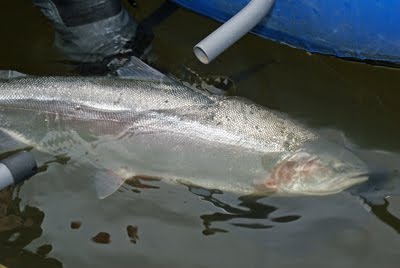

This trip could not have turned out any better.  Everyone caught fish and enjoyed each others company.  A real sense of team permeated the group as everyone pitched in to help out with food, clean up, loading and unloading boats and perhaps most of all sharing information regarding flies, locations and successful presentation techniques.

We are already planning on another hosted trip for the fall and another for 2011.  If trip interests you please let me know by emailing me at flycraft@shaw.ca.


To round this tale off and put it into perspective I have had the good fortune to chase trout on lakes right across North America including British Columbia, Alberta, Washington, Oregon and Alaska.  At this moment I don't think you can beat the stillwater fly fishing the Parklands region of Manitoba has to offer.  In my books that's saying something.  For example, when our group visited Tokaryk on the Saturday we were the only people on the lake!  The same was true for Pybus and we only shared Patterson with a few other anglers.  If you want a quiet remote experience, large average fish size, diversity of species visit the Parklands region and find out for yourself.  I doubt you will be disappointed.

Wednesday, June 2, 2010

Tough Conditions!

Who says fly fishers aren't tough!  Last Friday I spend an educational day guiding on Millers Lake located just west of Edson Alberta.  Weather reports were calling for overcast skies, 60% chance of rain and cool temperatures.  I confirmed with my client, Ruth the preceding day to see if was OK with the conditions.  Sunday was predicted to be a better day.  More on that later! Without hesitation she wanted to go.  We arrived on the water around 10am and begin setting up the boat and gear.  As with all clients I ran through the set up we would be using, the flies and rationale behind my plan of attack.  The goal of all of my trips is to educate clients on the charms of stillwaters so they can apply some of my approaches the next time they get on the water.

As conditions were dour I expected fish to be somewhat inactive, reluctant to chase the fly and to be located in the deeper regions.  My suspicions proved correct.  Our approach for the day involved hanging a small chironomid pupa about about 2-3 feet above a balanced Sparkle Leech under one of my Quick Release Indicators.   Within about half an hour we had our first fish of the day take Ruth's black & red Ice Cream Cone.  A careful throat analysis revealed zoo plankton. Confirmation once again that fish were hanging out along the deep water edges or suspending in deep water.  Zoo plankton are light sensitive and tend to stay deep during daylight hours.  As the day progressed trout changed their focus and began targeting the balanced leech.   I experimented with a number of depth settings and having eight feet between leech and indicator was the winning ticket.  We toughed things out until 5pm when the almost constant rain let up.  Thanks to my wife for the hot soup she provided for lunch.  It provided much needed warmth to our cores.


All in all it was a great day that exceeded my expectations given the conditions.  Ruth caught and released numerous fish with a few going at least four pounds.  Millers is clear lake so the resident rainbows are nickle bright.  Gorgeous well conditioned fish.


If my guiding season is going to proceed like this when conditions are challenging I can't wait for warmer weather to get the hatches going.  Don't worry I know better but still it is fun to dream.

I still have a few limited guide days available so if you are interested in spending some time with me please let me know right away.

Although the weather office called for better weather over the weekend it was not to be.  It turns out that Friday was the best day.  A nasty low pressure system rolled in from Montana and spat out ugly weather for the balance of the weekend. This included a couple of inches of snow.  The balance of my weekend was spend peering out of my window shaking my head extolling the virtues or lack there of when it comes to prairie springs!   I did have a chance though to catch up on my Fly Fusion column and prepare for my next trip.  Four days exploring the Parklands region of southwestern Manitoba for trophy browns, rainbows and the hyper aggressive tiger trout.  I will be provided a complete report when I return.